How to Order Food in France Without Speaking French: Menus, Etiquette, and Essential Phrases
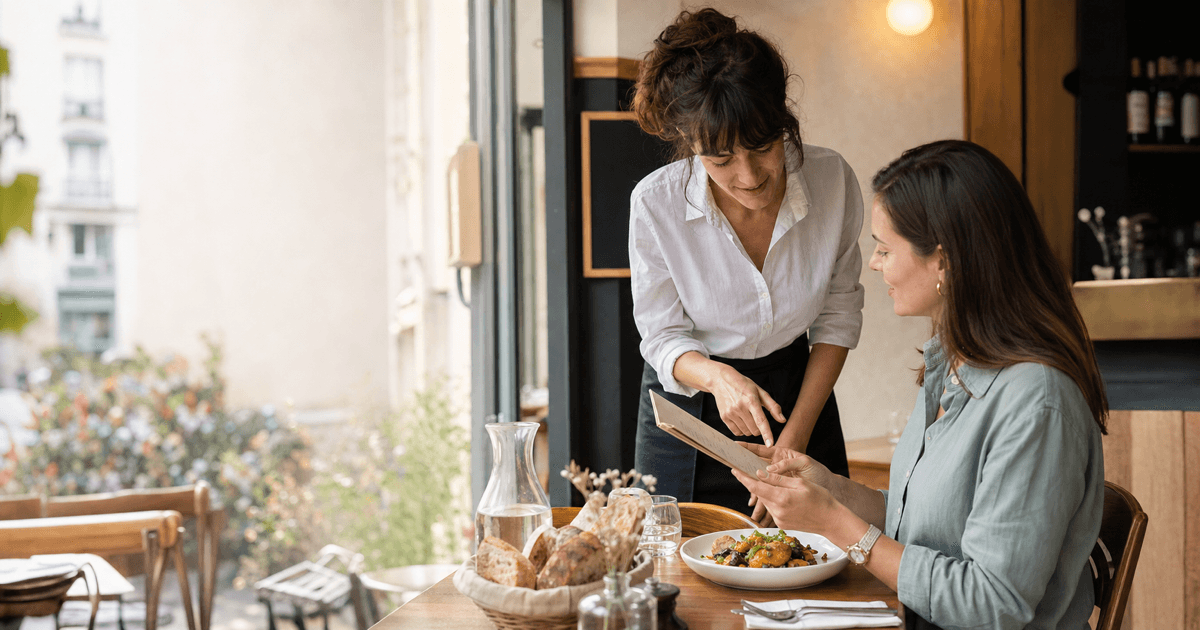
Yes, you can order confidently in France without speaking French. Start every interaction with Bonjour or Bonsoir, learn how a French menu is organized, use one polite ordering pattern such as Je voudrais..., and keep written French ready for dietary restrictions or anything that must be exact.
The language is only half the puzzle. French restaurants, cafés, bakeries, and markets each have their own rhythm. Knowing when to wait, what menu means, how to request free tap water, and how to ask for the bill can make the meal feel much easier.
This guide takes you from the door to the check, with useful French phrases, rough pronunciation, menu vocabulary, allergy guidance, and specific playbooks for restaurants, cafés, boulangeries, and markets.
Can you eat well in France without speaking French?
Absolutely. In major visitor destinations, some restaurant staff speak English and many menus include English translations. But you should not depend on either. A neighborhood bistro, village restaurant, bakery, market stall, or lunch special may be entirely in French.
Fortunately, the conversation is predictable. You mainly need to communicate:
- How many people are in your group
- Whether you have a reservation
- What you want to order
- How you want meat cooked
- What you cannot eat
- Whether you want tap water, bottled water, or another drink
- Whether you are eating there or taking the food away
- When you are ready for the bill
| Moment | Best first method | Useful backup |
|---|---|---|
| Entering | Greet staff and state the group size | Show the reservation name |
| Reading the menu | Translate one section at a time | Ask for une carte en anglais |
| Ordering | Use Je voudrais... and point |
Show a typed sentence |
| Understanding a choice | Ask staff to point to the options | Use a short A-or-B translation |
| Explaining an allergy | French chef card plus direct conversation | Ask for the allergen list and manager |
| Paying | Ask for l'addition |
Point to the check and show your card |
You do not need a long speech. A greeting, one clear sentence, and a visual reference will carry most of the meal.
What should you know before entering a French restaurant?
The most useful rule is simple: greet people before asking for something. Say Bonjour during the day or Bonsoir in the evening, then make your request. Walking in and immediately saying "Table for two" can feel abrupt even if the words are correct.
At a sit-down restaurant, pause near the entrance rather than choosing a table automatically. Staff may seat you, especially when some tables are reserved or assigned to a particular server.
Restaurant kitchens may also serve lunch and dinner during defined service periods rather than continuously all afternoon. Check opening hours and whether the restaurant requires a reservation. A café or brasserie may serve food for longer hours than a small restaurant.
Before your first meal:
- Save the restaurant name, address, and reservation in a screenshot.
- Look at the menu online if one is available.
- Translate your food restrictions into French.
- Save the phrase table in this guide offline.
- Keep a physical or digital payment backup.
- If you have a serious allergy, prepare a professionally translated chef card.
That preparation lets you focus on the meal instead of building every sentence while a server waits.
What is the difference between la carte, le menu, and la formule?
This distinction prevents one of the most common visitor misunderstandings.
La carte is the full list of individually priced dishes. Ordering à la carte means choosing separate items from that list.
Le menu often means a fixed-price combination of courses, not the physical menu in your hand. For example, a menu may include an appetizer and main course, or a main course and dessert.
La formule is another set combination, often offered at lunch. The exact choices and included drinks vary by restaurant.
| French menu term | Meaning |
|---|---|
| La carte | Full list of individually priced dishes |
| Le menu | Fixed-price set of courses |
| La formule | Set combination, often for lunch |
| Entrée | Starter or appetizer in France |
| Plat / plat principal | Main dish |
| Plat du jour | Dish of the day |
| Accompagnement | Side dish |
| Dessert | Dessert |
| Boissons | Drinks |
| Supplément | Extra charge |
| Fait maison | Made in-house under the applicable French definition |
| Service compris | Service is included in the displayed price |
In France, entrée is the first course, not the main course. If you see entrée + plat on a formula, it means starter plus main dish.
Which French phrases are most useful in a restaurant?
The pronunciation below is deliberately rough. It helps you get started, but listening to a native recording will give you a much better sense of French vowels and rhythm.
| English | French | Rough pronunciation |
|---|---|---|
| Hello / Good evening | Bonjour / Bonsoir | bohn-zhoor / bohn-swahr |
| A table for two, please. | Une table pour deux, s'il vous plaît. | ewn tah-bluh poor duh, seel voo pleh |
| I have a reservation under Liu. | J'ai une réservation au nom de Liu. | zhay ewn ray-zehr-vah-syohn oh nohm duh Lee-oo |
| I don't speak French well. | Je ne parle pas bien français. | zhuh nuh parl pah byan frahn-seh |
| Do you have a menu in English? | Avez-vous une carte en anglais ? | ah-vay voo ewn kart ahn ahn-gleh |
| What do you recommend? | Qu'est-ce que vous recommandez ? | kess kuh voo ruh-koh-mahn-day |
| I would like this, please. | Je voudrais ceci, s'il vous plaît. | zhuh voo-dreh suh-see, seel voo pleh |
| I'll have the dish of the day. | Je vais prendre le plat du jour. | zhuh vay prahndruh luh plah dew zhoor |
| What is in this dish? | Qu'est-ce qu'il y a dans ce plat ? | kess keel yah dahn suh plah |
| Is it spicy? | Est-ce que c'est épicé ? | ess kuh say ay-pee-say |
| Without [ingredient], please. | Sans [ingrédient], s'il vous plaît. | sahn [ingredient], seel voo pleh |
| A carafe of tap water, please. | Une carafe d'eau, s'il vous plaît. | ewn kah-rahf doh, seel voo pleh |
| The bill, please. | L'addition, s'il vous plaît. | lah-dee-syohn, seel voo pleh |
| Can I pay by card? | Est-ce que je peux payer par carte ? | ess kuh zhuh puh pay-yay par kart |
| To take away, please. | À emporter, s'il vous plaît. | ah ahn-por-tay, seel voo pleh |
| Thank you. Have a good day. | Merci. Bonne journée. | mehr-see, bun zhoor-nay |
If you learn only four phrases, choose:
Bonjour.Je voudrais ceci, s'il vous plaît.Une carafe d'eau, s'il vous plaît.L'addition, s'il vous plaît.
Pointing is not rude when it supports a polite sentence. Keep your finger next to the exact dish until the server confirms it.
How do you place an order politely in French?
Use one of two patterns:
Je voudrais... means "I would like..." It is polite and easy to reuse.
Je vais prendre... means "I'll have..." It is natural when ordering from a server.
For example:
Je voudrais la soupe à l'oignon, s'il vous plaît.— I would like the onion soup, please.Je vais prendre le poisson du jour.— I'll have the fish of the day.Pour moi, la formule entrée-plat.— For me, the starter-and-main formula.
Avoid beginning with Je veux..., which literally means "I want." It is understandable, but it can sound more direct than you intend.
Order one course or person at a time and pause. If you are using a translation app, prepare the sentence before the server arrives so the interaction does not become a long phone-editing session.
What might the server ask you?
Recognizing the question is often harder than placing the order. These are common possibilities:
| What you may hear | Meaning | Simple response |
|---|---|---|
| Vous avez réservé ? | Do you have a reservation? | Oui, au nom de... / Non. |
| Vous êtes combien ? | How many are you? | Deux personnes. |
| Vous avez choisi ? | Have you chosen? | Oui. / Encore une minute, s'il vous plaît. |
| Quelle cuisson ? | How would you like it cooked? | Saignant, à point, or bien cuit |
| Comme boisson ? | What would you like to drink? | Une carafe d'eau, s'il vous plaît. |
| Plate ou gazeuse ? | Still or sparkling? | Plate / Gazeuse |
| Sur place ou à emporter ? | For here or takeaway? | Sur place / À emporter |
| Vous désirez autre chose ? | Would you like anything else? | Non, merci. |
If you need more time, say:
Encore une minute, s'il vous plaît.
"One more minute, please."
If you do not understand, say:
Pouvez-vous répéter plus lentement, s'il vous plaît ?
"Could you repeat more slowly, please?"
Or show:
Pouvez-vous l'écrire ?
"Could you write it down?"
Written French is easier for a translation tool than a fast sentence in a noisy dining room.
How do you order meat at the right doneness?
When you order steak, duck breast, or another meat cooked to order, the server may ask Quelle cuisson ?
| French | Common meaning |
|---|---|
| Bleu | Very lightly seared, extremely rare inside |
| Saignant | Rare |
| À point | Medium to medium-rare depending on the restaurant and cut |
| Bien cuit | Well done |
These categories do not map perfectly to every country's scale. If the exact result matters to you, show a translated description rather than assuming à point will match your personal definition of medium.
For well done, say:
Bien cuit, s'il vous plaît.
For fish or eggs, ask a direct question about preparation rather than using the steak terms.
Is tap water free in French restaurants?
Yes, when you are a restaurant customer, you can ask for a free carafe of drinking water. The French consumer-protection authority states that restaurant customers may request une carafe d'eau without ordering bottled water. It also says displayed prices in establishments with table service include taxes and service. You can read the current rules on the French Ministry of Economy's restaurant consumer-rights page.
Ask for:
Une carafe d'eau, s'il vous plaît.
If the server asks plate ou gazeuse ?, they are asking whether you want still or sparkling water, often bottled. Repeat une carafe d'eau if you want tap water.
At a café, water practices can depend on what you order and how it is served, so ask rather than assume a bottle is free.
How do you communicate vegetarian, vegan, halal, or no-pork needs?
State the restriction and then name the ingredients you avoid. A broad label may not answer questions about stock, gelatin, lard, cheese, butter, or fish-based ingredients.
Useful phrases:
Je suis végétarien./Je suis végétarienne.— I am vegetarian.Je suis végane.— I am vegan.Je ne mange pas de viande ni de poisson.— I eat neither meat nor fish.Je ne mange pas de porc.— I do not eat pork.Est-ce que ce plat contient du bouillon de viande ?— Does this dish contain meat stock?Est-ce que cette viande est halal ?— Is this meat halal?
Then ask about the exact dish:
Est-ce que ce plat convient aux végétariens ?
"Is this dish suitable for vegetarians?"
If the answer is uncertain, choose a dish whose ingredients can be explained clearly.
How should you communicate a serious food allergy in France?
Tell the restaurant before ordering and carry a professionally translated French chef card. A severe allergy needs more than the phrase sans noix or an automatic translation generated at the table.
The French consumer-protection authority says restaurants must make written information about allergenic ingredients available, whether on the menu, on a sign, or in a document you can request from staff. Ask:
Puis-je voir la liste des allergènes, s'il vous plaît ?
"May I see the allergen list, please?"
You can also say:
J'ai une allergie alimentaire grave.
"I have a severe food allergy."
Food Allergy Research & Education provides a French chef-card template designed to communicate allergens and preparation needs to a chef or manager.
Show the card before ordering, ask that it reach the kitchen, and carry the medication and emergency plan recommended by your clinician. Written allergen information is helpful, but it does not guarantee that cross-contact cannot occur. If the restaurant cannot answer clearly, do not guess.
How do you order at a café in France?
A café has its own vocabulary. If you ask for un café, you will normally receive a small espresso rather than a large filtered coffee.
Common starting points include:
Un café, s'il vous plaît.— An espresso, please.Un café allongé, s'il vous plaît.— A longer coffee with more water.Un café crème, s'il vous plaît.— Coffee with milk or cream, with preparation varying by café.Un thé, s'il vous plaît.— Tea, please.Sur place.— For here.À emporter.— To take away.
Prices may differ between standing at the counter, sitting inside, and sitting on a terrace. Read the displayed prices or ask before choosing a seat.
Begin with Bonjour, even if you only want one coffee. That small greeting changes the tone of the exchange.
How do you order at a boulangerie or pâtisserie?
Wait until it is your turn, greet the staff member, and order items one at a time.
A simple pattern is:
Bonjour. Je voudrais une baguette tradition et deux croissants, s'il vous plaît.
"Hello. I would like one traditional baguette and two croissants, please."
You may hear Avec ceci ?, meaning "Anything else with that?" Reply:
Oui, un pain au chocolat, s'il vous plaît.— Yes, a pain au chocolat, please.Ce sera tout, merci.— That will be all, thank you.
If you want to point, say:
Celui-ci, s'il vous plaît. — This one, please, for a masculine item.
Celle-ci, s'il vous plaît. — This one, please, for a feminine item.
If you do not know the noun's gender, Je voudrais ceci plus pointing is a safe workaround.
How do you order at a market or food stall?
At a market, quantity matters. You may order by item, weight, slice, or portion.
Useful phrases include:
Je voudrais deux, s'il vous plaît.— I would like two, please.Je voudrais deux cents grammes.— I would like 200 grams.Une tranche, s'il vous plaît.— One slice, please.Combien ça coûte ?— How much does it cost?C'est tout, merci.— That's all, thank you.
Point to the exact product and watch the scale or price display. If you need an ingredient discussion or have a severe allergy, a busy open-air stall may not be the easiest setting.
How do you ask for the bill and tip correctly?
The server may not bring the bill until you ask for it. When you are ready, say:
L'addition, s'il vous plaît.
Displayed restaurant prices in France include taxes and service when service is charged. The French Ministry of Economy explains that the amount shown should be the amount the customer pays and that service must already be included in the bill. Extra tipping is therefore optional, not a second mandatory service charge. See the current French government guidance on service and tips.
If you particularly appreciated the service, you may leave small change or another modest amount. Do not assume the percentage expected in your home country applies in France.
Cards are widely accepted, but some smaller businesses may display a minimum purchase. Ask:
Est-ce que je peux payer par carte ?
If you want to pay separately:
On peut payer séparément ?
"Can we pay separately?"
Whether a restaurant can easily split the payment may depend on its system, so ask before everyone presents a card.
What if your phone has no signal or battery?
Keep a simple offline kit:
- Screenshots of your reservation and essential phrases
- A photo or saved French name of the dish you want
- Written dietary restrictions
- A printed French allergy card if needed
- Your accommodation address in French
- A power bank
- A backup card and some euros
- Pen and paper for a price or quantity
For an ordinary order, a polite greeting, pointing, and numbers are enough. For a severe allergy or another safety-critical need, wait until you can communicate clearly.
What is the easiest restaurant workflow to reuse across France?
Before the meal:
- Check opening hours and whether you need a reservation.
- Read the menu online and identify two possible dishes.
- Save restrictions and essential phrases offline.
- Prepare a payment backup.
At the restaurant:
- Say
BonjourorBonsoir. - State the number of people or reservation name.
- Wait to be seated.
- Decide between
la carte,le menu, orla formule. - Order with
Je voudrais...orJe vais prendre.... - Confirm doneness, drinks, and restrictions.
- Ask staff to write down anything you do not understand.
At the end:
- Ask for
l'addition. - Check whether you are paying together or separately.
- Leave an optional extra tip only if you want to.
- Say
Merci, bonne journéeorMerci, bonne soiréeas you leave.
The same few patterns work in Paris, Lyon, Nice, Bordeaux, Strasbourg, and small towns. The menu changes; the communication framework stays familiar.
Where does Leyo fit?
French restaurant language is full of small differences that a one-line translation can hide: une carte versus un menu, entrée versus a main course, or the tone difference between Je veux and Je voudrais.
With Leyo Translate, you can translate a real request, break the sentence into meaningful parts, hear the pronunciation, and understand the cultural context before you say it.
A menu photo can also become a tap-to-understand experience. Instead of translating the same word at every meal, you can start recognizing plat du jour, accompagnement, saignant, and service compris for yourself.
Use Leyo for everyday phrases, pronunciation, menu understanding, and cultural context. For severe allergies or medical needs, use professionally translated materials and follow your clinician's guidance.
Frequently asked questions
Can I visit France without speaking French?
Yes. Translation tools, written addresses, and basic preparation can handle most tourist situations. Learning greetings, numbers, food terms, and a few polite requests will make everyday interactions smoother.
Is it rude to order in English in France?
Not necessarily, but begin with Bonjour and ask Parlez-vous anglais ? rather than assuming. A greeting and a small effort in French usually matter more than perfect grammar.
What is the easiest phrase for ordering food in French?
Use Je voudrais..., s'il vous plaît, meaning "I would like..., please." You can say the dish name or point and use Je voudrais ceci, s'il vous plaît.
Does entrée mean the main course in France?
No. In France, entrée means the starter or first course. The main dish is le plat or le plat principal.
What does menu mean in a French restaurant?
It often means a fixed-price set of courses. The full list of individually priced dishes is la carte. Read which courses and drinks are included before ordering.
How do I ask for free tap water in France?
Say Une carafe d'eau, s'il vous plaît. Restaurant customers can request a free carafe of drinking water. Bottled still or sparkling water is a separate paid order.
How do I ask for the bill in French?
Say L'addition, s'il vous plaît. The bill may not be brought automatically, so ask when you are ready to leave.
Is tipping required in French restaurants?
No additional percentage is automatically required when the displayed price includes service. An extra tip for good service is optional. Check the bill for the restaurant's actual pricing information.
How do I tell a French restaurant about an allergy?
Say J'ai une allergie alimentaire grave, show a professionally translated French chef card, and ask Puis-je voir la liste des allergènes ? Tell staff before ordering and ask that the information reach the kitchen.
What if the server speaks too quickly?
Ask Pouvez-vous répéter plus lentement, s'il vous plaît ? or Pouvez-vous l'écrire ? A written answer is easier to translate accurately in a noisy restaurant.
The bottom line
You do not need fluent French to enjoy restaurants, cafés, bakeries, and markets in France. Greet people first, understand how the menu is structured, order with one polite sentence, keep important restrictions in writing, and ask rather than guess when a choice is unclear.
The goal is not to hide behind your phone. It is to use a little preparation and translation to enter the rhythm of the meal, understand more each time, and enjoy the human exchange around French food.