How to Do a Parent-Teacher Conference When You Don’t Speak the Language (Checklist + Messages)
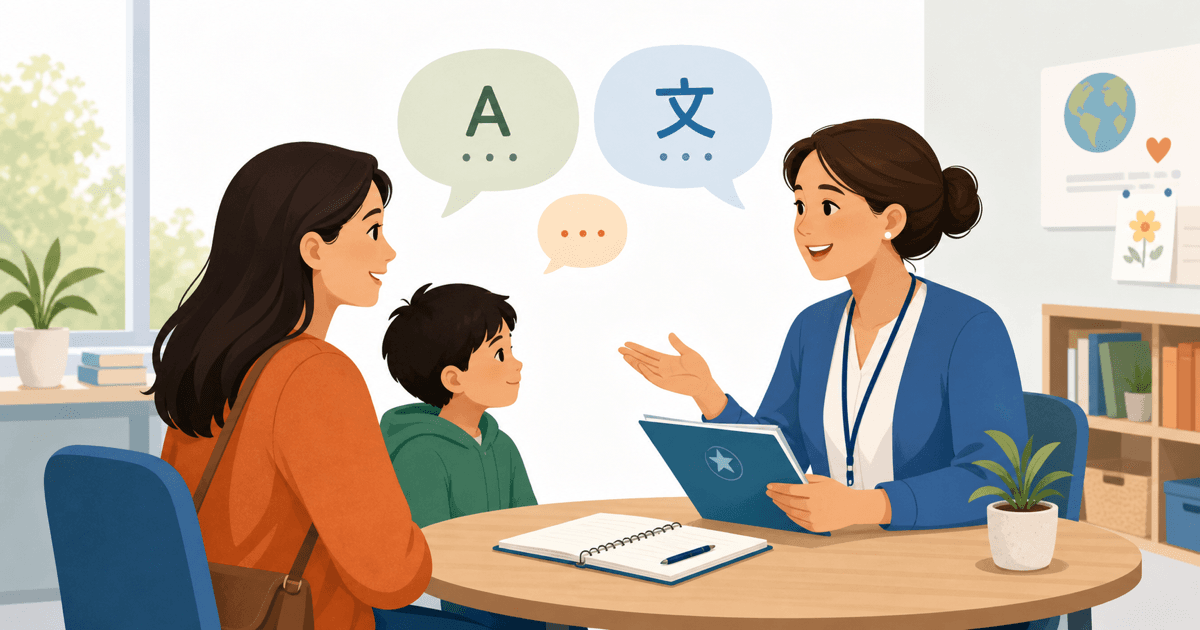
If you’re meeting your child’s teacher in a country (or school system) where you’re not fluent, it’s normal to feel anxious—especially when the topic is your kid. The good news: you don’t need perfect language skills to have a productive conference.
This guide gives you a simple plan you can use even if your vocabulary is limited. It focuses on clarity, respect, and follow-through—not sounding “native.”
The goal (keep it simple)
A parent-teacher conference is successful if you leave with:
- A clear picture of how your child is doing (academics + behavior + social)
- 2–4 specific next steps (for the teacher and for you)
- A plan for follow-up (what, who, and when)
Everything else is optional.
Step 1: Ask for language support early (if you can)
Many schools can provide an interpreter, translated documents, or a bilingual staff member—but they often need advance notice.
Message template: request an interpreter
Copy/paste and adjust:
Hello [Teacher/School Office],
I’m [Your Name], [Child’s Name]’s parent/guardian.
For our parent-teacher conference, I’m more comfortable in [Language].
Is an interpreter available, or can we arrange language support?
Thank you so much.
If you don’t know the right word for “interpreter,” you can say:
I speak [Language]. Do you have someone who can help translate?
If no interpreter is available
You still have options:
- Bring a trusted bilingual friend (ask the school if that’s allowed)
- Ask to do the conference by video call so you can use live captions/translation
- Ask to handle part of it in writing (translated email before/after)
Step 2: Send a tiny agenda (so you don’t get lost)
When you’re not fluent, structure is your best friend. Send 3–5 bullet points you want to cover. Teachers usually appreciate it.
Message template: mini agenda
Hi [Teacher Name],
Thank you for meeting with me. To help me understand clearly, I’d like to discuss:
- How [Child’s Name] is doing in class
- Strengths and areas to improve
- Behavior and participation
- Homework expectations
- Next steps and how we can support at home
Thank you!
Step 3: Bring your “core questions” (and stick to them)
Even if everything is translated, it’s easy to forget what you meant to ask. Print this list or keep it open on your phone.
Core questions (choose 6–10)
Learning
- What is my child doing well right now?
- What is the biggest challenge?
- Is my child at grade level? If not, in what area?
- What should we practice at home (15 minutes/day)?
Behavior & social
- How is my child’s behavior in class?
- How does my child get along with classmates?
- Does my child participate? Ask questions?
Support
- What resources does the school offer? (tutoring, counseling, language support)
- What’s the best way to communicate with you?
- What should we check again in 4–6 weeks?
Step 4: Use “slow communication” techniques during the meeting
These are small habits that prevent misunderstandings and reduce stress.
1) Ask for short answers, then details
Start with yes/no or 1-sentence answers, then ask for examples.
- “Is my child doing OK in math?”
- “Can you give one example?”
2) Confirm meaning (don’t pretend)
Use a simple repeat-back:
- “Let me check I understand: [your summary]. Is that correct?”
3) Ask for concrete examples
Abstract words are hard to translate. Examples translate better:
- “Can you show me one assignment or test?”
- “Can you describe what happens when there is a problem?”
4) Decide on 2–4 action items
Write them down as you go:
- “So the plan is: A, B, C. Is that right?”
Step 5: If you use translation, optimize for accuracy (not speed)
Translation works best when you reduce ambiguity.
Tips that help translation tools a lot
- Speak in short sentences (one idea at a time)
- Use names instead of pronouns (“my child” vs “he/she”)
- Avoid idioms (“doing great,” “falling behind”) and use plain words
- Ask the teacher to pause between points
If something sounds confusing after translation, assume the translation might be off—ask for a rephrase:
“Can you say that another way? Maybe with a simple example?”
Step 6: Send a follow-up message (this is where most parents win)
The follow-up doesn’t need to be perfect. It’s mainly to confirm next steps and keep communication open.
Message template: follow-up recap
Hi [Teacher Name],
Thank you again for meeting with me today. I want to confirm I understood correctly:
- Strengths: [1–2 bullets]
- Areas to improve: [1–2 bullets]
- Next steps:
- [Action item #1]
- [Action item #2]
- [Action item #3]
If anything is not accurate, please correct me.
Thank you for supporting [Child’s Name].
A simple “conference kit” you can prepare in 10 minutes
- Your mini agenda (printed or on your phone)
- Your core questions
- One recent graded assignment or note from school (if you have it)
- A note app for action items (with dates)
- A translation/captions setup if needed
Where Leyo fits (without adding more stress)
If you’ve ever left a parent-teacher conference thinking “I think I understood… but I’m not sure,” the problem isn’t your effort—it’s that cross-language conversations are hard to capture and follow up on.
Leyo is building AI-powered communication for global relationships—across languages and cultures. In practice, that means you can use:
- Leyo Meet for a video call with live captions and translation, so you can follow the conversation in real time
- A shared meeting memory (notes + action items) so the important points don’t disappear the moment the call ends
- Cross-language chat for follow-ups, so you can ask clarifying questions without scheduling another meeting
The best part: you don’t have to be “fluent” to be effective—you just need a clear process and a reliable way to capture what matters.
Quick recap
- Ask for language support early (interpreter if possible)
- Send a tiny agenda
- Bring core questions
- Confirm understanding and write action items
- Send a follow-up recap message
If you want, try running your next parent-teacher conference through Leyo Meet and keep the follow-ups in one shared thread—so language doesn’t get in the way of supporting your kid.