How to Order Food in South Korea Without Speaking Korean: Kiosks, BBQ, Banchan, and Essential Phrases
Yes, you can order food in South Korea without speaking Korean. The most reliable path is to identify the ordering system first, use short Korean phrases for the few moments that matter, rely on menu photos or image translation for dish names, and treat allergies or religious restrictions as written safety information rather than casual conversation.
The confusing part is that Korean restaurants do not all work the same way. A barbecue restaurant, baekban set-meal shop, food court, noodle counter, market stall, cafe, and kiosk-based chain can each have a different order-pay-pickup routine. This guide gives you the local vocabulary, practical phrase list, payment flow, etiquette, allergy safeguards, and offline backup for the actual meal.
Can you eat well in South Korea without speaking Korean?
Yes. In Seoul, Busan, Jeju, and other visitor-heavy areas, many restaurants have photos, English menu labels, table tablets, or kiosks with an English option. Outside those areas, a few Korean words and a clear phone screen are often enough.
Before choosing a dish, answer five practical questions:
- Is this staff service, counter ordering, a kiosk, a table tablet, or a QR menu?
- Are you ordering a single-person meal or a dish with a minimum number of servings?
- Are water, utensils, and side dishes self-serve?
- Do you need to confirm spice, meat, broth, seafood, nuts, wheat, soy, or cross-contact?
- Do you pay first, pay at the counter after eating, or pay through a machine?
| What you need | Best first method | Useful backup |
|---|---|---|
| A table | Hold up the number of diners and say 두 명이에요 |
Show 2 people on your phone |
| Menu help | Photograph the menu and translate dish by dish | Point to a photo and ask 이거 뭐예요? |
| Ordering | Say 이거 하나 주세요 while pointing |
Use the kiosk photo menu |
| Less spice | Ask 안 맵게 해주세요 |
Choose broth, rice, noodle, or grilled dishes that are not red |
| Allergy safety | Show a written Korean allergy card | Ask staff to confirm with the kitchen |
| Payment | Take the bill slip or receipt to the counter | Ask 카드 돼요? and carry some cash |
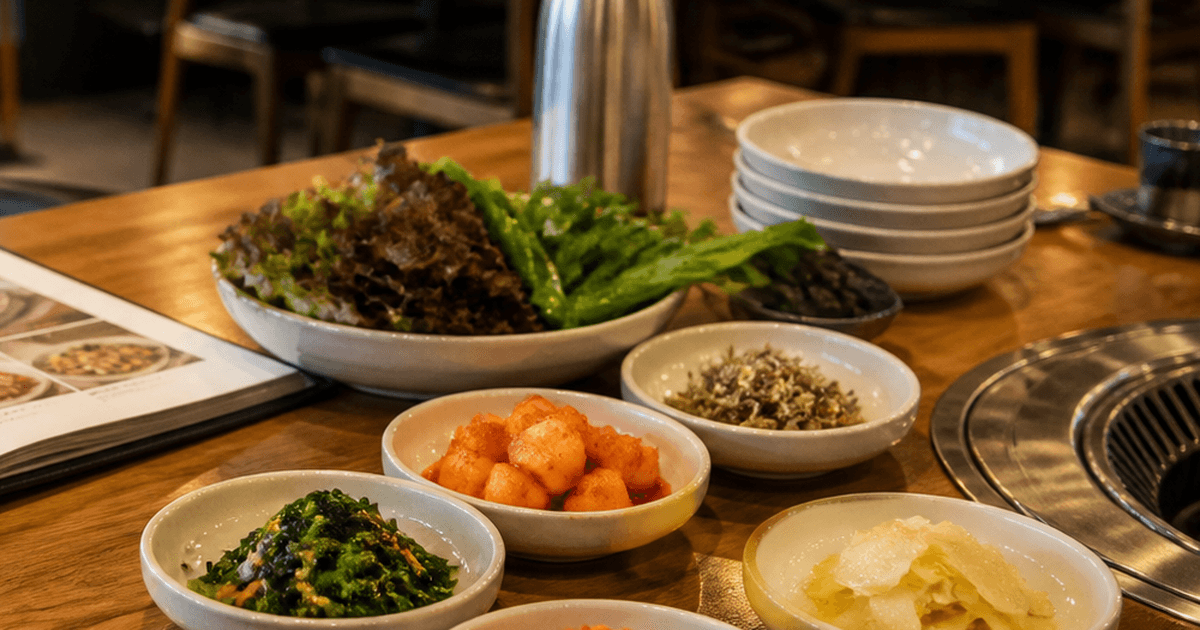
VisitKorea's Korean food guide explains that a Korean table often includes rice, soup, a main dish, and multiple banchan side dishes arranged together, so understanding the table format matters as much as translating a single menu word (VisitKorea food guide).
What should you prepare before your first meal?
Prepare a small restaurant kit while you still have a good connection. You do not need a full Korean phrasebook; you need a few short phrases, your restrictions in writing, and a way to understand menus and payment screens.
- Save your hotel address and restaurant destination offline.
- Screenshot your key Korean phrases.
- Save allergies, medications, or religious food restrictions in Korean and English.
- Add a credit card to your phone wallet, but carry small cash for markets, older shops, and machine failures.
- Practice saying
주세요(juseyo, please give me) and계산할게요(gyesanhalgeyo, I will pay). - Save the Korea Tourism Organization 1330 helpline number:
1330in Korea or+82-2-1330from overseas.
KTO says 1330 offers tourism information and interpretation help in multiple languages and can connect travelers to emergency-related services when needed (1330 Travel Helpline). That is useful for travel interpretation; it is not a replacement for emergency medical care.
How do Korean restaurant ordering systems work?
Read the ordering channel before reading every dish name. In Korea, the same meal can feel easy or stressful depending on whether you are expected to sit, press a call bell, order at a counter, pay at a kiosk, or watch for a pickup number.
| Ordering style | What to look for | What to do |
|---|---|---|
| Staffed table | Menu booklet, call bell, server entering order | Sit, press the call bell when ready, point and order |
| Counter order | Register near the entrance or kitchen | Order and often pay first, then wait for food |
| Kiosk | Touch screen near the door | Find English if available, choose pictures, pay, keep the receipt |
| Table tablet | Screen on the table | Check quantity and table number before submitting |
| QR menu | QR code on table | Use your phone, check whether payment is separate |
| Food court | Numbered receipt or buzzer | Pay first, watch the number, collect your tray |
| Korean BBQ | Grill in table, meat menu by serving | Order at least the minimum number of servings, ask if staff grills |
If you are unsure, point at the counter or screen and ask 여기서 주문해요? (yeogiseo jumunhaeyo?, do I order here?). That one question prevents most first-minute confusion.
What Korean phrases should you know before ordering?
Use polite, short Korean. In a restaurant, -주세요 is the safest ending for most simple requests. The romanization below follows standard Korean romanization principles published by the National Institute of Korean Language, with a few plain-English sound hints for practical use (NIKL Romanization of Korean).
| English intent | Korean | Pronunciation |
|---|---|---|
| Hello | 안녕하세요 | annyeonghaseyo |
| Excuse me | 저기요 | jeogiyo |
| Menu, please | 메뉴판 주세요 | menyupan juseyo |
| This one, please | 이거 주세요 | igeo juseyo |
| One of this, please | 이거 하나 주세요 | igeo hana juseyo |
| Two servings, please | 2인분 주세요 | i-inbun juseyo |
| Not spicy, please | 안 맵게 해주세요 | an maepge haejuseyo |
| Please remove this | 이거 빼 주세요 | igeo ppae juseyo |
| Water, please | 물 좀 주세요 | mul jom juseyo |
| More side dishes, please | 반찬 더 주세요 | banchan deo juseyo |
| To go, please | 포장해 주세요 | pojanghae juseyo |
| I will pay | 계산할게요 | gyesanhalgeyo |
| Can I pay by card? | 카드 돼요? | kadeu dwaeyo? |
| Receipt, please | 영수증 주세요 | yeongsujeung juseyo |
If pronunciation feels hard, show the Korean text. That is often clearer than reading a long sentence aloud under pressure.
How do you read a Korean menu without guessing?
Start with categories, not individual dish names. Many Korean menu words tell you the structure of the meal.
| Korean menu word | Pronunciation | What it usually means | Ordering note |
|---|---|---|---|
| 정식 | jeongsik | Set meal | Often main dish plus rice, soup, and banchan |
| 백반 | baekban | Home-style set meal | Good solo lunch format |
| 국밥 | gukbap | Soup with rice | Usually solo-friendly |
| 찌개 | jjigae | Stew | Often shared or served bubbling hot |
| 비빔밥 | bibimbap | Mixed rice bowl | Watch for egg, beef, and gochujang |
| 냉면 | naengmyeon | Cold noodles | Broth may contain beef or dongchimi |
| 삼겹살 | samgyeopsal | Pork belly BBQ | Often ordered by serving, sometimes two-serving minimum |
| 갈비 | galbi | Ribs | Beef or pork depending on menu |
| 닭갈비 | dakgalbi | Spicy stir-fried chicken | Usually shared on a hot plate |
| 분식 | bunsik | Casual snack food | Gimbap, tteokbokki, noodles, fried snacks |
| 추가 | chuga | Add-on / extra | Use for extra meat, noodles, rice, or toppings |
| 셀프 | selpeu | Self-service | Look for water, utensils, side dishes, or tray return |
| 포장 | pojang | Takeout | Useful at counters and street-food shops |
VisitKorea describes baekban as a set-meal style built around rice, soup, and several side dishes, and notes that set menus often take their names from the main dish (VisitKorea set menu guide). That is why 고등어정식 is not just "mackerel" but usually a mackerel set meal.
How do you order at a staffed restaurant?
At a staffed restaurant, sit where directed or where the room flow suggests. Look for a call bell on the table. In many Korean restaurants, pressing the bell when you are ready is normal; waiting for the server to check in may just slow you down.
- Greet the staff:
안녕하세요. - Say the number of diners if asked:
두 명이에요for two people. - Read the ordering system: menu booklet, call bell, tablet, or staff.
- Point to the dish and quantity:
이거 하나 주세요. - Confirm spice or restrictions before the order is sent.
- Eat, then take the bill slip to the front counter if no one brings payment to the table.
Official Seoul tourism etiquette guidance says tipping is not customary in Korea and gives basic dining manners such as using a spoon for rice, not leaving chopsticks standing in rice, and placing utensils back when finished (Visit Seoul etiquette).
What changes at kiosks, food courts, and table tablets?
Kiosks are common in casual chains, cafes, food courts, burger shops, noodle places, and some fast Korean restaurants. The screen may have an English button, but the English can be partial or missing for specials.
Use this sequence:
- Choose dine-in or takeout:
매장can mean eat in;포장means takeout. - Choose category, dish, quantity, and options.
- Check the cart before paying.
- Pay by card or mobile wallet if accepted.
- Keep the receipt, buzzer, or waiting number.
- Watch the screen or listen for your number.
- Return trays only if a
반납or return station is clearly marked.
If a kiosk declines a foreign card, do not keep repeating the same payment. Ask staff: 카드 안 돼요. 도와주세요. That means "The card is not working. Please help."
How do banchan, water, utensils, and call bells work?
Banchan are the small side dishes served with many Korean meals. They may arrive automatically, or they may be at a self-service station. Water and utensils may be on the table, in a drawer under the table, at a side station, or brought by staff.
Look for these words:
| Korean sign | Pronunciation | Meaning |
|---|---|---|
| 셀프 | selpeu | Self-service |
| 물 | mul | Water |
| 수저 | sujeo | Spoon and chopsticks |
| 반찬 | banchan | Side dishes |
| 앞접시 | apjeopsi | Small individual plate |
| 냅킨 | naepkin | Napkin |
| 반납 | bannap | Return |
| 퇴식구 | toesikgu | Tray return area |
Take only what you need from a self-service station. If side dishes are brought to the table, ask before assuming refills are unlimited. 반찬 더 주세요 is a normal request, but allergies still matter: kimchi, sauces, soups, and vegetable dishes can contain seafood, wheat, soy, sesame, or chili paste.
What should you know about Korean BBQ?
Korean BBQ is one of the easiest meals visually and one of the easiest to misunderstand operationally. Meat is usually ordered by serving, not by one plate per person, and some restaurants require a minimum order. Staff may grill the meat for you, start it for you, or expect your table to cook it.
Useful BBQ words:
| Need | Korean | Pronunciation |
|---|---|---|
| Pork belly | 삼겹살 | samgyeopsal |
| Beef ribs | 소갈비 | sogalbi |
| Pork ribs | 돼지갈비 | dwaeji galbi |
| Beef | 소고기 | sogogi |
| Pork | 돼지고기 | dwaejigogi |
| Lettuce wraps | 쌈 | ssam |
| Soybean paste sauce | 쌈장 | ssamjang |
| Garlic | 마늘 | maneul |
| Scissors | 가위 | gawi |
| Tongs | 집게 | jipge |
Ask 구워 주세요? only if you need help grilling. A more complete phrase is 고기 구워 주실 수 있어요? (gogi guwo jusil su isseoyo?, could you grill the meat for us?). If staff say no or gesture to the table, cook slowly, keep raw meat utensils separate from eating utensils, and ask for help if the grill smokes heavily.
VisitKorea's food guide explains ssam as wrapping rice or meat in leafy vegetables with sauces and additions such as garlic or chili (VisitKorea food guide). Make each wrap small enough to eat in one bite; that is neater than biting through a large wrap over shared dishes.
How do payment and tipping work?
South Korea is card-friendly, and the Bank of Korea describes Korea's payment system as including cash and non-cash instruments such as credit cards and account transfers, with retail payment systems widely established (Bank of Korea payment systems). A 2025 Bank of Korea survey reported by Yonhap found credit cards were the top consumer payment method in 2024, while cash remained meaningful for face-to-face transactions (Yonhap on BOK payment survey).
For a traveler, that means:
- Cards work in many restaurants, cafes, and chains.
- Some kiosks, markets, old shops, or foreign-card terminals can fail.
- Cash is still useful for small vendors, traditional markets, and backup.
- Payment is often at the front counter when you leave.
- Tipping is not customary; do not leave money on the table unless the venue clearly asks for a service charge or tip.
Useful payment phrases:
| English intent | Korean | Pronunciation |
|---|---|---|
| I will pay | 계산할게요 | gyesanhalgeyo |
| Can I pay by card? | 카드 돼요? | kadeu dwaeyo? |
| Cash | 현금 | hyeongeum |
| Please split it | 따로따로 계산해 주세요 | ttarottaro gyesanhae juseyo |
| Receipt, please | 영수증 주세요 | yeongsujeung juseyo |
| It did not work | 안 됐어요 | an dwaesseoyo |
Among friends, one person paying and others transferring money later is common, but visitors should not assume a restaurant can split every bill at a busy counter. Ask early if separate payment matters.
What if you have a food allergy or strict dietary restriction?
Treat allergies as high-stakes communication. Do not rely on a translated dish name alone. Korean broths, marinades, kimchi, sauces, batters, dumplings, pancakes, noodles, and banchan can hide ingredients that are not obvious from the main dish name.
The Ministry of Food and Drug Safety lists Korea's food allergen labeling items for packaged foods, including eggs, milk, buckwheat, peanuts, soybeans, wheat, mackerel, crab, shrimp, pork, peach, tomato, sulfites at specified levels, walnuts, chicken, beef, squid, clams including oyster, abalone and mussel, and pine nuts (MFDS food labeling system). Restaurant practice is not the same as a packaged-food label, so use this as a reminder to ask clearly, not as a guarantee that every menu is safe.
| English intent | Korean | Pronunciation |
|---|---|---|
| I have a severe allergy to... | 저는 ...에 심한 알레르기가 있어요 | jeoneun ...e simhan allereugiga isseoyo |
| I cannot eat... | 저는 ...을/를 못 먹어요 | jeoneun ...eul/reul mot meogeoyo |
| Does this contain peanuts? | 이거 땅콩 들어가요? | igeo ttangkong deureogayo? |
| Does this contain wheat? | 이거 밀 들어가요? | igeo mil deureogayo? |
| Does this contain soy? | 이거 콩 들어가요? | igeo kong deureogayo? |
| Does this contain shrimp or shellfish? | 이거 새우나 조개 들어가요? | igeo saeuna jogae deureogayo? |
| Is the broth meat-based? | 육수에 고기 들어가요? | yuksue gogi deureogayo? |
| Is there cross-contact risk? | 교차 오염 위험이 있어요? | gyocha oyeom wiheomi isseoyo? |
| Please ask the kitchen | 주방에 확인해 주세요 | jubange hwaginhae juseyo |
| I need emergency help | 응급 도움이 필요해요 | eunggeup doumi piryohaeyo |
For severe allergies, carry prescribed medication, bring a professionally prepared Korean allergy card, avoid buffets and shared grills when cross-contact is likely, and skip a dish when the answer is uncertain. Translation can help you communicate; it should not replace medical advice, emergency services, or a trained interpreter in a serious situation.
For emergencies in Korea, VisitKorea says police are 112, fire and medical emergencies are 119, and the 1330 hotline can help with non-life-threatening interpretation and travel assistance (VisitKorea emergency FAQ).
What should vegetarians, vegans, halal diners, and people avoiding pork ask?
Ask about specific ingredients instead of relying only on a category label. A dish that looks vegetable-based may use anchovy broth, beef stock, fish sauce, shrimp paste, egg, pork, or gochujang containing wheat or soy.
| Need | Korean question | What to confirm |
|---|---|---|
| Vegetarian | 고기나 해산물 들어가요? | Meat, seafood, broth, fish sauce |
| Vegan | 고기, 해산물, 계란, 우유 들어가요? | Meat, seafood, egg, dairy, stock |
| No pork | 돼지고기 들어가요? | Pork, ham, lard, pork broth |
| Halal concern | 술이나 돼지고기 들어가요? | Alcohol, pork, broth, shared grill |
| No beef | 소고기 들어가요? | Beef broth, garnish, dumplings |
| No seafood | 해산물 들어가요? | Anchovy broth, shrimp paste, squid, shellfish |
If the restriction is religious or medical, write it down in Korean and ask staff to confirm with the kitchen. A busy lunch counter may not be able to redesign a dish, and it is better to choose a simpler restaurant than negotiate a complex substitution through a language barrier.
Which translation mode works best in a Korean restaurant?
Image translation is best for menus, wall signs, kiosk screens, receipts, and allergy sheets. Take a clear photo, translate one dish at a time, and watch for ingredient words such as pork, beef, seafood, wheat, soy, and nuts.
Short typed translation is best for allergies, restrictions, and payment questions. One sentence per screen is safer than a long paragraph.
Voice or live conversation is best when staff are willing to speak into the phone, especially for a table-service restaurant or hotel concierge call. Ask first and keep it brief.
Human escalation is best for severe allergies, medical symptoms, emergencies, legal disputes, lost property, or a payment conflict where a mistranslation could create harm.
What changes in common situations?
- You are at a small
baekbanshop: Order one set meal, expect rice, soup, and side dishes, and watch whether water and utensils are self-service. - You are at Korean BBQ: Confirm the serving count, ask whether staff grills the meat, and do not assume one serving is enough for one person.
- You are using a kiosk: Choose photos first, check quantity before payment, and ask staff if a foreign card fails.
- You are eating street food: Pointing is normal. Use
이거 하나 주세요, pay immediately, and eat where the stall flow allows. - You are in a market: Carry cash, ask price with
얼마예요?, and confirm whether food is for here or to go. - You are in a cafe: Order at the counter or kiosk, keep the receipt or buzzer, and listen for your drink number.
- You are solo: Look for
국밥,비빔밥, noodles, kimbap, cafes, food courts, and set meals. BBQ, hot pot, and some stews may require two servings. - You do not understand a question: Say
천천히 말씀해 주세요(cheoncheonhi malsseumhae juseyo, please speak slowly) or show a translated message.
What if your phone or connection fails?
Plan for one meal without internet. That keeps a dead battery or weak signal from becoming a crisis.
- Keep screenshots of your phrase table, allergies, hotel address, and restaurant reservation.
- Save a map pin for your hotel and nearest subway station.
- Carry a paper allergy card for serious restrictions.
- Bring a power bank.
- Carry small cash.
- Write your dish choice and quantity on paper if needed.
- Save
1330,112, and119in your phone. - Ask a hotel desk, restaurant manager, pharmacist, police officer, or 1330 operator for help when the situation is beyond ordinary ordering.
What is the reusable Korean restaurant checklist?
Before:
- Save Korean phrases and restrictions offline.
- Add card to your phone wallet and carry small cash.
- Check whether the restaurant is BBQ, set meal, cafe, market, food court, or kiosk-based.
- Screenshot any reservation name or address in Korean.
During:
- Greet with
안녕하세요. - Identify the order path before choosing dishes.
- Point, confirm quantity, and use short Korean.
- Ask about spice, broth, pork, seafood, wheat, soy, nuts, or allergies before ordering.
- Watch for
셀프signs for water, utensils, side dishes, and tray return.
After:
- Take the bill slip or receipt to the counter if needed.
- Ask
계산할게요or카드 돼요? - Do not tip unless the venue clearly directs it.
- Save dish names and useful phrases you want to remember for the next meal.
Where does Leyo fit?
Leyo helps when the meal is more than a one-word translation. Use Leyo Translate to break down menu names, hear pronunciation, and understand whether a phrase sounds polite or too blunt. Use image understanding for menus, wall signs, kiosk screens, receipts, and allergy cards. If you are traveling with someone who speaks another language, Leyo chat and calls can keep plans, preferences, and follow-up messages clear across languages.
For allergies, medical symptoms, or urgent safety issues, use Leyo as a communication aid, not as a substitute for emergency services, professional medical advice, or a trained interpreter.
Frequently asked questions
What is the easiest Korean phrase for ordering food?
Use 이거 주세요, which means "this, please." If you need one serving, say 이거 하나 주세요. Pointing while saying it is normal and clear.
What does 주세요 mean?
주세요 means "please give me" or "please do this for me" depending on the phrase. In restaurants, it is the most useful polite ending for simple requests like menu, water, one dish, takeout, or a receipt.
Do Korean restaurants have English menus?
Many restaurants in tourist areas, chains, hotels, food courts, and newer kiosks have English labels or photo menus. Smaller neighborhood restaurants may not. Image translation and a few Korean menu words are still useful.
Can I pay by card in South Korean restaurants?
Usually, yes. Korea is very card-friendly, but some kiosks, market stalls, older shops, or foreign-card terminals can fail. Carry small cash as a backup.
Should I tip in South Korea?
No, tipping is not customary in ordinary Korean restaurants. Official Seoul tourism guidance says some people may accept a tip and some may refuse it, so follow the venue's own practice rather than applying U.S. tipping habits.
Are banchan free?
Many Korean restaurants include side dishes with the meal, and some refills are free or self-service. The exact policy depends on the restaurant, so ask before taking more if there is a sign, special side dish, buffet counter, or allergy concern.
What should I say if I cannot eat spicy food?
Say 안 맵게 해주세요, which means "please make it not spicy." This does not work for every dish because some foods are prepared in advance, so choose a non-red dish or ask staff for a mild recommendation if spice is a serious problem.
What should I do if I have a severe food allergy in Korea?
Bring a Korean allergy card, ask staff to confirm with the kitchen, and avoid dishes when the answer is uncertain. For a medical emergency, call 119; for travel interpretation or non-life-threatening help, use 1330.
The bottom line
Ordering food in South Korea without speaking Korean is manageable when you read the process first. Learn 이거 주세요, 안 맵게 해주세요, 반찬 더 주세요, and 계산할게요; use image translation for menus and kiosks; keep allergy and payment details written clearly; and carry an offline backup for the meal that does not go as planned.