How to Order Food in Spain Without Speaking Spanish: Tapas, Menus, and Essential Phrases
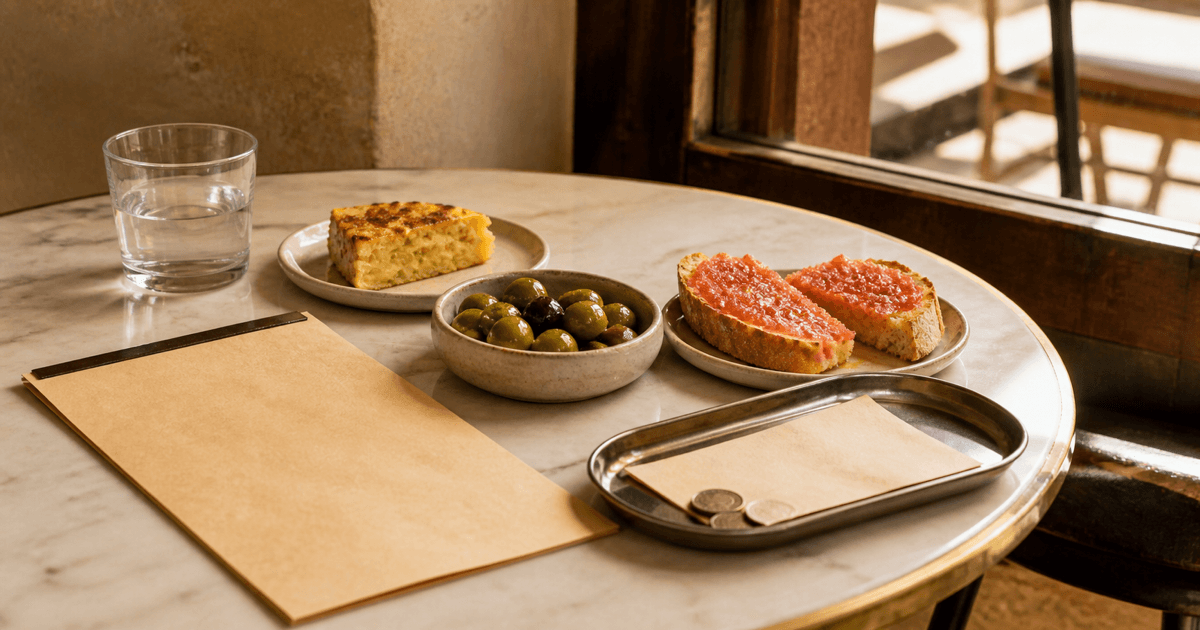
Yes, you can order food in Spain without speaking Spanish. The easiest path is to learn a few Spain-specific phrases, understand the difference between la carta, el menú del día, tapas, and raciones, use image translation for menus, and confirm allergies, payment, and the bill in short written Spanish.
The biggest mistake is assuming "Spanish restaurant" means one script. A Madrid tapas bar, a Barcelona market counter, a Valencia rice restaurant, a Basque pintxos bar, and a beach chiringuito all move differently. This guide gives you the local vocabulary, ordering phrases, payment workflow, allergy safeguards, and offline backup that help in the actual moment.
Can you eat well in Spain without speaking Spanish?
Yes. In major visitor areas, many staff understand some English, and menus may have translations. But the most useful meals are often in smaller bars, neighborhood restaurants, markets, and towns where the menu is in Spanish or Catalan, Basque, Galician, or another regional language.
For a first meal, focus on five decisions:
- Whether you want a full sit-down meal or small plates.
- Whether the fixed lunch
menú del díais available. - Whether you are ordering for yourself or sharing.
- Whether any ingredient or allergy issue must be exact.
- Whether the place accepts card for a small bill.
| What you need | Best first method | Useful backup |
|---|---|---|
| A table | Say ¿Tienen mesa para dos? |
Show the number on your phone |
| Menu help | Photograph the menu and translate dish by dish | Ask ¿Qué recomienda? |
| Tapas or sharing | Say Para compartir |
Point at plates other tables have ordered |
| Allergy safety | Show a written allergy card in Spanish | Ask for written allergen information |
| Payment | Ask ¿Puedo pagar con tarjeta? |
Carry small euro notes and coins |
| The bill | Say La cuenta, por favor |
Gesture writing and say cuenta |
What should you prepare before your first meal?
Prepare a small Spain restaurant kit before you leave Wi-Fi. You do not need to memorize a phrasebook; you need the few phrases that cover arrival, ordering, questions, dietary restrictions, and payment.
- Save your hotel address and restaurant reservation offline.
- Screenshot your allergies or dietary restrictions in Spanish.
- Save the phrase
Sin [ingredient], por favorfor ingredients you cannot eat. - Add a card to your phone wallet, but carry small cash for bars, markets, and connection failures.
- Practice
quisieraandpara compartir; they solve many restaurant interactions politely.
Also set expectations around meal timing. Lunch in Spain often runs later than in the United States, and dinner can start late. Kitchens may close between lunch and dinner, while bars and cafes may still serve snacks, sandwiches, pastries, or drinks.
How do you get a table?
Start with a greeting, then ask for a table by number. In casual bars, you may seat yourself, stand at the bar, or wait to be shown a table depending on the room. Watch the flow for a moment before interrupting busy staff.
| English intent | Spanish for Spain | Pronunciation |
|---|---|---|
| Hello / good day | Buenos días | BWEH-nos DEE-ahs |
| Good afternoon / evening | Buenas tardes | BWEH-nas TAR-des |
| Good evening / night | Buenas noches | BWEH-nas NOH-ches |
| Excuse me | Perdón | pehr-DON |
| Do you have a table for two? | ¿Tienen mesa para dos? | TYEH-nen MEH-sah PAH-rah dos |
| I have a reservation | Tengo una reserva | TEHN-goh OO-nah reh-SEHR-bah |
| In the name of Liu | A nombre de Liu | ah NOM-breh deh Liu |
| Is the kitchen open? | ¿Está abierta la cocina? | ehs-TAH ah-BYEHR-tah lah koh-THEE-nah |
In much of Spain, c before e or i and z are often pronounced like English th, so cocina may sound closer to koh-THEE-nah. In parts of Andalusia, the Canary Islands, and Latin America, it is often pronounced with an s sound. Either pronunciation will be understood.
How do you read a Spanish menu in Spain?
Read the menu by format first, then by dish. In Spain, la carta is the a la carte menu. Menú often means a fixed-price meal, especially menú del día at lunch, usually with choices for a first course, second course, dessert or coffee, and a drink. Do not assume menú means the same thing as the English word "menu."
| Spanish menu word | What it usually means | Ordering note |
|---|---|---|
| La carta | A la carte menu | Choose individual dishes |
| Menú del día | Fixed lunch menu | Often best value on weekdays |
| Tapas | Small plates or bar snacks | May come free with drinks in some regions, but often ordered |
| Raciones | Larger sharing plates | Better for a group |
| Media ración | Half portion | Useful when two people want to try several dishes |
| Plato combinado | Combined plate | Simple full plate, often casual |
| Bocadillo | Sandwich on bread | Common in bars and cafes |
| Pincho / pintxo | Small bite, especially northern Spain | Often ordered at the bar |
| Postre | Dessert | Sometimes included in a fixed menu |
| Pan | Bread | May be charged if served |
Local food vocabulary matters. Tortilla in Spain usually means a potato omelet, not a Mexican-style flatbread. Jamón often means cured ham. Gambas are prawns or shrimp. Pulpo is octopus. Boquerones are anchovies. Callos are tripe. A quick image translation pass can save you from ordering the wrong familiar-looking word.
How do you order food politely?
Use a short phrase, point if needed, and let the server repeat it back. In Spain, Quisiera... is polite and useful, while ¿Me pone...? or ¿Me trae...? are common in bars and restaurants. If you are unsure, quisiera is the safest all-purpose choice.
| English intent | Spanish for Spain | Pronunciation |
|---|---|---|
| I would like... | Quisiera... | kee-SYEH-rah |
| For me, the tortilla | Para mí, la tortilla | PAH-rah mee, lah tor-TEE-yah |
| We are going to share | Vamos a compartir | BAH-mos ah kom-par-TEER |
| What do you recommend? | ¿Qué recomienda? | keh reh-koh-MYEHN-dah |
| One moment, please | Un momento, por favor | oon moh-MEN-toh por fah-BOR |
| We are ready to order | Estamos listos para pedir | ehs-TAH-mos LEES-tos PAH-rah peh-DEER |
| Could you bring me water? | ¿Me trae agua? | meh TRAH-eh AH-gwah |
| Tap water | Agua del grifo | AH-gwah del GREE-foh |
| Still water | Agua sin gas | AH-gwah seen gahs |
| Sparkling water | Agua con gas | AH-gwah kohn gahs |
If a phrase feels too long, simplify it. Esto, por favor while pointing means "this, please." It is not elegant, but it is clear.
What if the server asks a question you do not understand?
Most restaurant questions are predictable. Listen for words about drinks, portion size, sides, meat doneness, dessert, coffee, and payment.
| You might hear | Likely meaning | Simple answer |
|---|---|---|
¿Para beber? |
What would you like to drink? | Agua sin gas, por favor |
¿Con gas o sin gas? |
Sparkling or still water? | Sin gas or con gas |
¿Para compartir? |
Is this for sharing? | Sí, para compartir |
¿Algo más? |
Anything else? | No, gracias |
¿Postre o café? |
Dessert or coffee? | Café, por favor or No, gracias |
¿Tarjeta o efectivo? |
Card or cash? | Tarjeta or efectivo |
If the answer still does not land, say Perdón, ¿puede repetir más despacio? That means "Sorry, can you repeat more slowly?" If you still miss it, show a translated message on your phone instead of pretending you understood.
How do tapas, raciones, pintxos, markets, and cafes work?
The ordering pattern changes by setting.
- Tapas bar: You may stand at the bar, order a drink, and add one or two small plates. In some cities, a small tapa may come with a drink; in others, tapas are ordered and charged separately. Ask
¿Qué tapas tienen? - Raciones restaurant: Order several larger plates for the table and say
para compartir. This is often better than everyone ordering a separate main course. - Pintxos bar: In places such as the Basque Country, small bites may be displayed at the bar. Ask before taking anything if you are unsure, and keep track of what you order.
- Market counter: Pointing is normal. Ask
¿Cuánto cuesta?for price andpara llevarif you want it to go. - Cafe or bakery: Order at the counter when it is busy. Useful words include
café con leche,cortado,bocadillo,napolitana, andpara llevar. - Rice restaurant or seafood place: Some dishes, such as paella or arroz, may be priced per person or require a minimum number of diners. Confirm before ordering.
Regional language can appear on menus. In Catalonia you may see Catalan, in the Basque Country Basque, in Galicia Galician, and in Valencia Valencian. Spanish is still widely useful, but image understanding helps when the menu is not in standard Castilian Spanish.
How do payment, tipping, and the bill work?
Ask about card before ordering if you are in a small bar, market, rural town, or buying a low-cost item. Spain is card-friendly, but cash is still useful when a terminal fails or a small place prefers it. Banco de España notes that cash payments over EUR 1,000 are generally not allowed when one party is acting as a business or professional; for a non-resident consumer not acting professionally, the limit is EUR 10,000. That law rarely affects an ordinary meal, but it is a useful reminder that Spain still has specific cash-payment rules.
For the bill, ask for it. Servers may not bring it until requested.
| English intent | Spanish for Spain | Pronunciation |
|---|---|---|
| The bill, please | La cuenta, por favor | lah KWEHN-tah por fah-BOR |
| Can I pay by card? | ¿Puedo pagar con tarjeta? | PWEH-doh pah-GAR kohn tar-HEH-tah |
| Do you accept cards? | ¿Aceptan tarjetas? | ah-SEP-tan tar-HEH-tahs |
| Cash | Efectivo | eh-fek-TEE-boh |
| Receipt | Recibo / ticket | reh-THEE-boh / TEE-ket |
| Separate bills? | ¿Podemos pagar por separado? | poh-DEH-mos pah-GAR por seh-pah-RAH-doh |
Tipping in Spain is more modest than in the United States. A service charge is not normally handled like U.S. tipping culture, and many local diners leave nothing for a casual coffee or simple meal. For good table service, rounding up or leaving small coins is common; a large percentage tip is optional, not expected.
What if you have a food allergy or medical restriction?
Treat allergies as safety-critical, not as ordinary translation. Spain follows EU allergen disclosure rules, and AESAN explains that allergen information is mandatory for non-prepacked foods in retail and hospitality settings such as bars, cafes, and restaurants. The establishment may provide the information orally, but it must have the information available in writing or electronic form for consumers who ask.
That helps, but it does not remove the risk of cross-contact, staff confusion, or regional dish names. If you have a serious allergy, bring a professionally prepared allergy card in Spanish, carry prescribed medication, ask for written allergen information, and avoid dishes when the answer is uncertain.
| English intent | Spanish for Spain | Pronunciation |
|---|---|---|
| I have a severe allergy to... | Tengo una alergia grave a... | TEHN-goh OO-nah ah-LEHR-hyah GRAH-beh ah |
| I cannot eat... | No puedo comer... | noh PWEH-doh koh-MEHR |
| Does this contain milk? | ¿Contiene leche? | kohn-TYEH-neh LEH-cheh |
| Does this contain nuts? | ¿Contiene frutos secos? | kohn-TYEH-neh FROO-tos SEH-kos |
| Does this contain gluten? | ¿Contiene gluten? | kohn-TYEH-neh GLOO-ten |
| Is there cross-contact risk? | ¿Hay riesgo de contaminación cruzada? | eye RYEHS-goh deh kon-tah-mee-nah-THYON kroo-THAH-dah |
| I need urgent medical help | Necesito ayuda médica urgente | neh-theh-SEE-toh ah-YOO-dah MEH-dee-kah oor-HEN-teh |
For emergencies in Spain and across the EU, call 112. Translation can help you explain symptoms, location, and allergens, but medical decisions should come from qualified clinicians or emergency responders.
What should vegetarians, vegans, halal diners, and people avoiding pork ask?
Use specific ingredient questions instead of relying only on broad labels. Vegetariano and vegano are understood, but Spanish dishes can include ham, fish, seafood stock, egg, cheese, lard, or anchovies even when the menu name sounds vegetable-based.
| Need | Ask this in Spanish | What to confirm |
|---|---|---|
| Vegetarian | ¿Es vegetariano? |
No meat, fish, seafood, or meat stock |
| Vegan | ¿Es vegano? |
No meat, fish, dairy, egg, honey, or stock |
| No pork | ¿Lleva cerdo o jamón? |
Ham, chorizo, bacon, lard, pork stock |
| No alcohol | ¿Lleva alcohol? |
Wine sauces, desserts, marinades |
| No shellfish | Sin marisco, por favor |
Shellfish, stock, frying oil cross-contact |
| No cheese or milk | Sin queso ni leche |
Cheese, cream, butter, sauces |
If the reason is religious, medical, or severe, write it down in Spanish and ask staff to confirm with the kitchen. Do not rely on visual guessing from a translated menu name.
Which translation mode works best in a Spanish restaurant?
Image translation is best for menus, chalkboards, receipts, market labels, and allergen sheets. Take a clear photo and translate dish names one at a time.
Short typed translation is best for restrictions, payment questions, and polite requests. Keep one idea per message: "I have a severe nut allergy" is safer than a long paragraph.
Voice or live conversation mode is best when the server is willing to speak into the phone. Ask first, keep it brief, and do not record nearby guests.
Human escalation is best for severe allergies, medical symptoms, emergency services, legal disputes, or payment conflicts where a mistranslation could cause harm.
What changes in common situations?
- You are at a busy tapas bar: Order at the bar, keep your request short, and add plates gradually.
Una tapa de tortilla y una caña, por favoris enough. - You want to share everything: Say
Vamos a compartirbefore ordering. Ask for extra plates with¿Nos trae platos pequeños? - The menu has no English: Translate the image, identify unfamiliar proteins, then ask one direct question:
¿Qué lleva?means "What does it contain?" - You are eating lunch on a weekday: Ask
¿Tienen menú del día?It may be the simplest value option. - You need tap water: Ask for
agua del grifo. Some places default to bottled water, so say it clearly. - You are in a tourist-heavy area: Confirm prices, bread charges, and whether the menu is a fixed menu or a la carte before ordering.
- You are in Catalonia, the Basque Country, Galicia, or Valencia: Spanish still helps, but local-language menu words may appear. Use image understanding rather than guessing.
What if your phone or connection fails?
Prepare for one meal without internet. This turns a language problem into a manageable inconvenience.
- Keep screenshots of your key phrases, allergy card, reservation, and address.
- Save the Spanish names of ingredients you avoid.
- Carry a paper card for serious allergies or medical restrictions.
- Bring a power bank.
- Carry small cash for bars, markets, and terminal failures.
- Save a map pin for your hotel.
- Ask a hotel desk, pharmacist, police officer, or restaurant manager for help if the situation becomes urgent.
What is the quick ordering checklist?
Before:
- Save the restaurant address and reservation offline.
- Screenshot allergies or restrictions in Spanish.
- Learn
quisiera,para compartir,la cuenta, andsin [ingredient]. - Carry card plus small cash.
During:
- Greet first:
Buenos días,Buenas tardes, orBuenas noches. - Ask for a table or show the reservation name.
- Decide whether you want
la carta,menú del día, tapas, or raciones. - Order with
quisieraorpara compartir. - Confirm restrictions before ordering, not after the food arrives.
After:
- Ask for the bill with
La cuenta, por favor. - Check whether bread, service, or extras were charged.
- Save any dish names or phrases you want to remember.
Where does Leyo fit?
Leyo helps when the meal is more than a one-word translation. Use Leyo Translate to break down a menu phrase, hear pronunciation, and understand whether a request sounds polite or too blunt. Use image understanding for menus, chalkboards, receipts, signs, and reservation messages. If you are traveling with someone who speaks another language, Leyo chat and calls can keep preferences, plans, and follow-up messages clear across languages.
For allergies, medical symptoms, or urgent safety issues, use Leyo as a communication aid, not as a substitute for professional medical help, emergency services, or a trained interpreter.
Frequently asked questions
What is the easiest phrase for ordering food in Spain?
Use Quisiera..., which means "I would like..." It is polite, flexible, and works for food, drinks, and most simple requests. If you forget it, point and say Esto, por favor.
Should I say tapas or raciones?
Use tapas for small plates or bar snacks and raciones for larger sharing plates. If you are with other people and want to share, say Vamos a compartir.
What does menú del día mean in Spain?
Menú del día is usually a fixed-price lunch menu with limited choices, not just the list of available dishes. It can be the easiest option if you want a complete meal without reading a long menu.
Can I pay by card in Spanish restaurants?
Usually, yes, especially in cities and sit-down restaurants. Still ask ¿Puedo pagar con tarjeta? in small bars, markets, rural areas, or low-cost places, and keep cash as a backup.
Should I tip in Spain?
Tipping is modest and optional compared with the United States. For casual service, locals may leave nothing or small change. For good table service, rounding up or leaving a few euros is enough.
What should I do if I have a severe food allergy in Spain?
Bring a professionally translated allergy card, ask for allergen information, and avoid dishes when staff are unsure. Spain and the EU require allergen information, but severe allergies still need extra caution because cross-contact and misunderstanding can happen.
Is it rude to use a translation app at the table?
It is fine if you use it briefly and respectfully. Translate your own menu, show short questions, and ask before using live voice translation with staff.
What if I cannot pronounce Spanish well?
Lead with a polite greeting, speak slowly, and show the written phrase if needed. Clear intent matters more than perfect pronunciation.
The bottom line
To order food in Spain without speaking Spanish, learn a few local phrases, know the difference between la carta, menú del día, tapas, and raciones, use image translation for menus, confirm restrictions clearly, and keep an offline backup. You do not need restaurant-level Spanish. You need enough shared meaning for the server, the kitchen, and you to agree on the same meal.
Sources checked
- Official Tourism Portal of Spain: Spain, a country with one of the best cuisines in Europe
- Official Tourism Portal of Spain: Food and wine tourism
- AESAN: Alergias e intolerancias alimentarias
- European Food Safety Authority: Food allergens
- Banco de España: Limit on cash payments
- European Consumer Centre Spain: cash payments maximum amount
- CIEE: Essential Spanish restaurant phrases in Spain