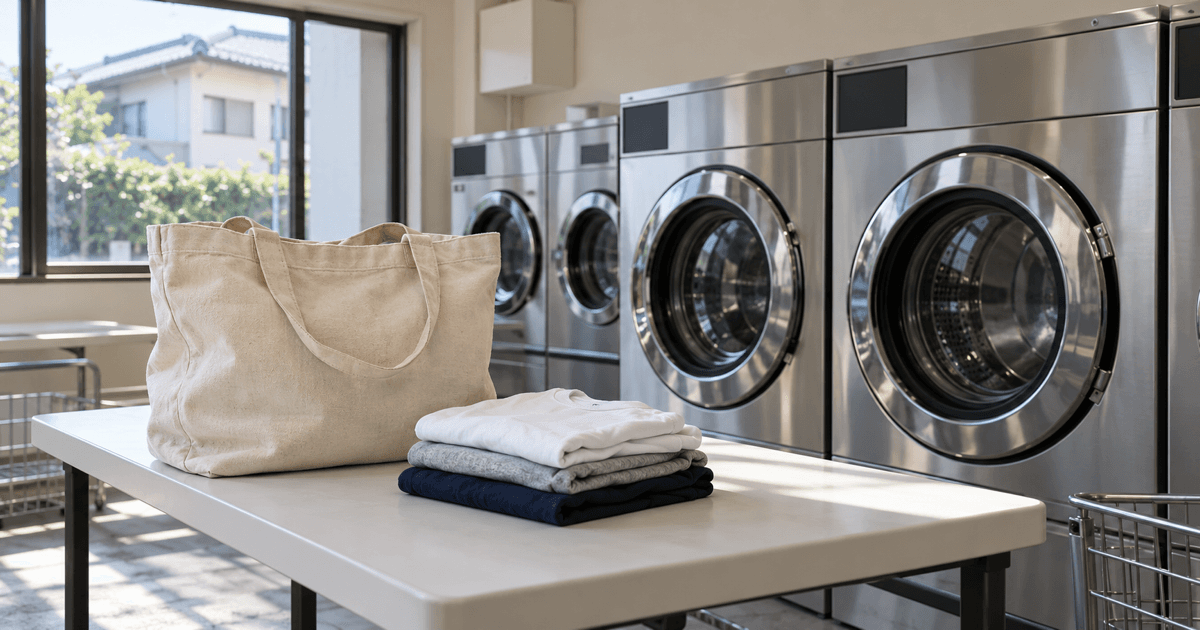
You can use a coin laundry in Japan without Japanese by identifying whether the machine washes, dries, or does both, checking whether detergent is automatic, and reading the payment instructions before inserting money. Photograph the whole control panel, match the machine number to the payment point, and follow that machine's sequence. Keep delicate clothes out of an unfamiliar drying cycle until you understand the temperature and garment-care instructions.
The confusing part is usually a small decision: whether you must move wet clothes to another drum, whether a button selects washing or drying, or whether payment starts the machine immediately. This guide gives you the labels to recognize, a practical sequence, and a way to ask for help without needing a conversation about laundry in Japanese.
Which machine should you choose?
Start with the job you need done. A large circular door does not tell you whether a machine washes clothes or only dries them.
| Your situation | What to identify | What to confirm before paying |
|---|---|---|
| Dirty everyday clothes, all suitable for tumble drying | A washer-dryer combination and its wash-and-dry course | The load limit for that course and whether drying is included |
| Clothes that need different drying methods | A washer or a wash-only course | Where you can dry each item afterward |
| Already washed, wet clothes | A dryer or a clearly marked dry-only course | Temperature, paid running time, and correct drum |
| A few travel garments | A machine appropriate to the amount of laundry | The posted load guidance, rather than choosing the biggest drum |
| Shoes, bedding, or a special fabric | A dedicated service or instructions for that exact item | Whether both the item manufacturer and laundry operator permit it |
WASHHOUSE's combination-machine instructions distinguish washing/drying, washing, and drying courses. The machine can do several jobs, but the selected course determines which one you buy. A wash-only choice will not become wash-and-dry simply because the equipment has both functions.
Check the load guidance for the selected course, including any separate washing and drying limits. If you cannot confidently match the amount of clothing to the instructions, ask the operator before loading.
What should you bring and check before leaving the hotel?
Bring your clothes in a bag, keep a separate clean bag for the return trip, and check pockets for tissues, coins, earphones, and travel documents. Sort anything with uncertain care instructions into a separate pile rather than making the whole load depend on a guess.
Before walking over, save:
- The laundry's address and route back to your accommodation.
- Opening hours and any last-use or closing instructions.
- A screenshot of its own operating guide, if available.
- Your accommodation's contact details, in case you need help explaining a problem.
Carry some yen coins as a fallback, then check which denominations the machine accepts. Do not assume it gives change or that a change machine takes every banknote. If you plan to use an app, confirm you can actually complete its payment setup before relying on it.
Allow time to finish and collect the load before your next train or hotel checkout. A displayed washing time is not a promise that separate drying, folding, and a walk back will fit into the same interval.
Which Japanese words and phrases are useful?
These are standard Japanese labels and polite expressions suitable for a traveler. Labels are recognition aids, not sentences to say to another customer.
| Meaning | Japanese | Reading and romanization |
|---|---|---|
| Washing / laundry | 洗濯 | せんたく — sentaku |
| Washing machine | 洗濯機 | せんたくき — sentakuki |
| Dryer | 乾燥機 | かんそうき — kansōki |
| Detergent | 洗剤 | せんざい — senzai |
| Fabric softener | 柔軟剤 | じゅうなんざい — jūnanzai |
| Hand washing | 手洗い | てあらい — tearai |
| Excuse me / sorry | すみません | sumimasen |
| Once more, please | もういちど、お願いします。 | mō ichido, onegaishimasu |
The laundry vocabulary and kana readings are checked against Wasabi's Japanese tutor lesson. The polite clarification expressions come from the Japan Foundation's Irodori Starter Lesson 2, which also provides romanized examples.
In the romanization here, ō is a held “o” sound and ū a held “u” sound; this is the same long-vowel distinction often written oo or uu in learning materials. Romanization helps you get started, but listening to a recording is better than guessing English stress.
For a specific problem, show a short translated message and the relevant panel. Prepare one question at a time:
Does this course wash and dry the clothes?
Is detergent added automatically?
Please show me which machine number to choose.
I paid for this machine, but it has not started.
These English source messages are intended for translation. Keep the machine number, amount paid, and error code outside the translated sentence too, so the original details remain visible.
How do you start a load without paying for the wrong thing?
Read the numbered instructions on the actual machine before acting. There is no single payment-and-button order that works everywhere.
For example, Mammaciao's operating guide describes coin or prepaid-card payment followed by course selection and a Start press on its illustrated combination machines. WASHHOUSE's guide describes a combination machine starting automatically once the displayed coin payment is complete. Treat those as examples of why the local instructions matter.
Use this decision sequence alongside the posted operating sequence:
- Inspect the empty drum. Check for forgotten items and obvious dirt. If a separate drum-cleaning function is available, read its instructions before putting clothes inside; it is not your clothing wash cycle.
- Identify the machine and course. Record the machine number. Confirm wash-and-dry, wash-only, or dry-only before committing money.
- Check detergent and clothing suitability. Resolve both before starting. Remove any garment that should not go through the selected cycle.
- Load and close as instructed. Keep clothing clear of the door seal and follow the posted load guidance.
- Pay at the correct point. On a shared payment terminal, compare the selected number with the physical machine again. On stacked dryers, identify the upper or lower drum and its payment controls.
- Confirm operation. Check that the expected machine begins the selected cycle and that its display changes as described. Save the finish time or set a timer.
Do not insert a test coin just to see what happens. That can start a cycle or commit a payment before you have loaded the clothes.
Do you need detergent, and can you pay by card or phone?
Check detergent separately from payment. A coin slot does not reveal whether soap is included.
WASHHOUSE's washer instructions state that detergent and softener are automatically added on the described machines. Mammaciao also identifies automatic detergent in its guide. Do not add a pod or liquid to those machines on top of the automatic supply. At another laundry or in a hotel, read that machine's instructions rather than extending a chain's policy to every washer in Japan.
Cashless payment is similarly specific. WASHHOUSE's app instructions describe scanning the code attached to a machine, choosing the relevant options, and completing payment. That does not establish that your foreign card, phone, or account will work at another operator's terminal.
If a payment fails, check the transaction status and machine display before trying repeatedly. Keep any receipt or confirmation. For help, show the machine number, approximate payment time, amount, and whether the clothes are already inside.
For detergent sensitivity, ask about the exact product and whether automatic detergent or softener can be disabled. A translated label or an empty-drum rinse is not proof that a shared machine is free of a substance you need to avoid. If this affects a medical condition, use your clinician's advice rather than an AI assurance of safety.
How do you avoid shrinking clothes or choosing the wrong dryer?
Read the garment's care label before choosing the temperature. A square containing a circle is a tumble-drying symbol; a crossed-out version means do not tumble dry. Japan's Consumer Affairs Agency care-label guide explains these symbols and their temperature markings. Do not confuse the standalone circle used for professional cleaning with permission to use a laundromat dryer.
If the label and the machine settings cannot be reconciled confidently, set that item aside for an appropriate cleaning service. A delicate garment does not become suitable because you select fewer minutes.
For a stacked dryer, trace the controls to the drum containing your clothes before paying. WASHHOUSE's dryer guide specifically warns that upper and lower dryers may have different coin slots. When the cycle finishes, inspect dryness before buying more time, and follow the machine's instructions for any extension.
Keep fire safety separate from translation convenience. Japan's electrical manufacturers' association warns against tumble drying oil-contaminated fabrics even after washing, because residual oil can generate heat and cause a fire. Do not use extra heat as a solution for an oily garment. Follow the operator's prohibited-item notices and manufacturer instructions.
What if the machine stops, the door stays locked, or someone else's clothes are inside?
For a stopped machine, photograph the error code and machine number. Contact the operator through the number posted at that location. Do not force a locked door, reach into a moving drum, or keep adding money to clear an unexplained problem.
If you selected the wrong course or paid for the wrong machine, explain that before attempting another cycle. Ask the operator what can be changed and how the payment will be handled; a refund or remote reset is not guaranteed at every shop.
For an occupied machine, choose another or follow the site's posted procedure. Do not treat a timer reaching zero as permission to handle a stranger's belongings. Set your own collection reminder and return promptly: WASHHOUSE's shared-use guidance asks customers to remove finished laundry promptly and observe its item restrictions.
Keep folding surfaces usable, separate your dirty-clothes bag from clean clothes, and check the drum and door area before leaving. These small habits make the next person's turn easier.
What changes for hotel laundry, shoes, or a last-day wash?
At a hotel: ask reception whether the machines are self-service, how to pay, whether detergent is included, and when the laundry room closes. A staffed laundry service with a collection form is a different service; confirm the price and return time before handing anything over.
For shoes or bedding: check the dedicated machine instructions and the item's care requirements. Do not put shoes into a clothing washer because another shop advertises a sneaker machine. If you cannot verify suitability, choose another service.
For clothes with different care needs: make a wash-only plan and separate the items before drying. Decide where the non-dryer items will finish drying without assuming you can hang them anywhere in your accommodation.
Before departure: prioritize essential, straightforward garments. If you have a fixed checkout or train time, choose a service whose collection time you can meet, or postpone the load. Wet clothes and a locked running machine are difficult problems to solve while rushing to leave.
What should you do if your phone or connection fails?
Carry a small paper note with your accommodation's name and contact number. Before starting, write down the laundry address, machine number, amount paid, chosen course, and expected finish time. Keep a few suitable coins separate from your phone.
Save the vocabulary table and the operator's own instructions beforehand, then check that the saved files open without a connection. This is a saved-reference backup, not a promise that a translation app works offline.
If you still cannot identify a control, pause before payment and ask your hotel or the operator for help. Pointing to a machine number and a printed question is more useful than repeating a long explanation louder.
Where does Leyo help with a Japanese laundry visit?
Use Leyo Translate to prepare a short question and understand its wording and pronunciation before asking for help. Leyo's image understanding can help you explore the text on a photographed sign or control panel; include the surrounding instructions, not just an isolated button.
Compare any interpretation with the actual machine number, selected course, price, and operator guide before paying. Translation cannot determine a garment's heat tolerance or override a safety notice. Keep your saved instructions and paper note available even when using Leyo.
Frequently asked questions
Can tourists use coin laundries in Japan?
Yes, you can use a self-service laundry by following its posted instructions and payment requirements. Check access, hours, accepted items, and the particular machine's controls before starting.
Is detergent included in Japanese coin laundry machines?
It is automatic on the WASHHOUSE and Mammaciao machines described in their guides, but you should verify the individual machine. Do not add your own detergent unless its instructions call for it.
Do Japanese laundromats accept credit cards or Suica?
Do not assume either. Check the specific operator and payment terminal; an app-payment option does not mean every card or transit payment method is accepted. Carry suitable yen coins as a backup.
How much does laundry cost, and how long does it take?
Use the price and time displayed for your chosen machine and course. Size, wash-only versus wash-and-dry, and additional drying change the total. Include collection and folding time in your plan.
Can I leave while the clothes wash?
Follow the site's rules and return before the cycle ends. Keep valuables with you and record the machine number. If the laundry is near closing or you have a departure deadline, stay close enough to handle a problem.
What should I do if I cannot understand the Japanese controls?
Photograph the entire panel, identify the machine number, and consult the operator's illustrated or English guide. If the course or payment sequence remains unclear, ask for help before inserting money. Save the confirmed instructions for the next visit.