How to Order Food in Germany Without Speaking German: Bakeries, Imbiss Counters, and Beer Gardens
You can order food in Germany without speaking German by pointing to the exact menu item, adding a polite bitte (please), and confirming whether you are eating in or taking away. Check which payment methods the place accepts before ordering, and carry some euros as backup. For a serious food allergy, bring a prepared German allergy card and ask staff to check with the kitchen before you choose anything.
The part that catches visitors out is often the process rather than the vocabulary. A bakery counter, an Imbiss snack shop, a sit-down restaurant, and a Munich beer garden may each have a different place to order and pay. Start by watching where other customers go, then handle one decision at a time.
Can you order with English, pointing, and a few German words?
Yes. You do not need to speak a whole sentence to make an ordinary order clear. Show one dish, indicate the quantity with your fingers, and wait for staff to confirm it before moving to the next item. English can help if staff speak it, but an English menu is not something to assume everywhere.
| Where you are | First thing to check | Practical ordering method |
|---|---|---|
| Bäckerei: bakery | Counter queue and eat-in or takeaway choice | Point to the roll or pastry; show quantity |
| Imbiss: snack shop or stand | Where to order, collect, and pay | Use the item name or menu number; confirm sides |
| Restaurant or Gasthaus | Whether the table is available and how service works | Show the menu line; ask for the bill when ready |
| Biergarten: beer garden | Self-service or table-service area | Follow the counter queue in a self-service area |
| Digital ordering screen | Eat-in/takeaway option and payment choices | Switch language if offered; ask staff if stuck |
These are starting points, not rules for every business. If the arrangement is unclear, show staff the menu and gesture toward the counter or table before settling in.
What should you save before you get hungry?
Save a short phrase card, a photo of any dish you want to try, and the address of your accommodation. Keep the German names of your dietary restrictions in a separate note. Download an offline language pack if your chosen translator offers one, and test it in airplane mode; do not assume every translation feature works offline.
For payment, take your card and enough euros for an ordinary meal or snack. Before committing to an order, show your actual card to staff. A general card symbol does not tell you whether that particular business accepts your network.
For an allergy, prepare the card before travelling, with your exact allergens checked by a competent German speaker. A vague note saying “no nuts” can miss the specific ingredient you need to avoid.
How do you order at a bakery or Imbiss counter?
Keep the order in the same sequence the counter needs to process it.
- Choose before reaching the front. Photograph the display label or menu line if you need time to translate it.
- Point to one item. State its name if you can, then show how many you want.
- Choose eat-in or takeaway.
Hiermeans here;zum Mitnehmenmeans to take away. The latter is standard German, with spelling and usage documented by Duden. - Confirm additions. Look separately at sauces, sides, drink size, and any displayed extra price. Do not assume a photo shows everything included in the price.
- Follow the collection process. Keep your receipt, order number, or buzzer if given one; watch the pickup area.
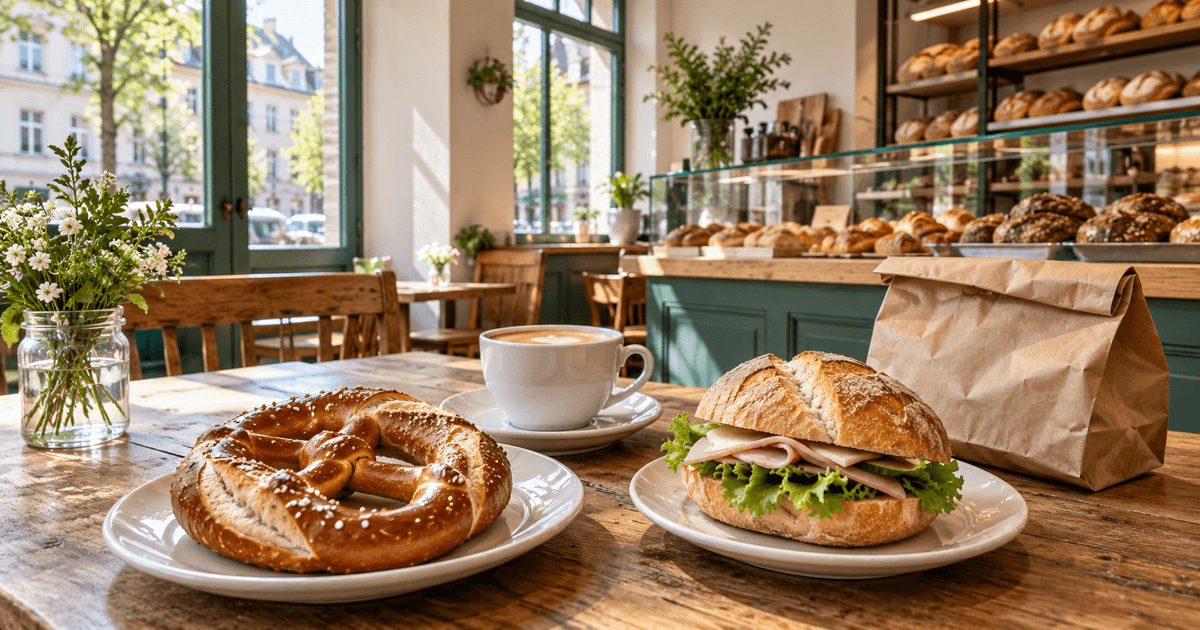
In a bakery, a belegtes Brötchen is a filled bread roll. Read the filling, not just the bread name: cheese, ham, or another filling may be visible only in the description. In Bavaria, you may see Semmel for a bread roll and Brezn for a pretzel; pointing to the actual item avoids having to master regional vocabulary.
At an Imbiss, order the listed product rather than guessing what comes with it. If you want fries with a sausage, check whether Pommes appears in that specific offer. For a kebab or sandwich, confirm the displayed filling and sauce choices individually. A translation of the dish name cannot establish its ingredients.
Which polite German phrases are worth learning?
Use standard German with staff you do not know. Sie is the formal “you.” Short requests with bitte are useful in both northern and southern Germany; you do not need to imitate a local dialect.
The pronunciation cues below are approximations for English speakers. Capital letters mark stress. ch in ich and Rechnung is a soft breathy sound, not an English “k”; German z sounds like “ts.” For the rounded vowel ö, round your lips while aiming toward an “eh” sound. Use the Goethe-Institut pronunciation exercises for the German sounds and Deutsche Welle's restaurant vocabulary for the core restaurant phrases.
| Your intent | German | Approximate pronunciation |
|---|---|---|
| Please | Bitte | BIT-uh |
| Thank you | Danke | DANG-kuh |
| I will have a soup | Ich nehme eine Suppe. | ikh NAY-muh EYE-nuh ZOO-puh |
| The bill, please | Die Rechnung, bitte. | dee REKH-noong, BIT-uh |
| Together or separately? | Zusammen oder getrennt? | tsoo-ZAH-men OH-duh guh-TRENT |
| Takeaway | Zum Mitnehmen | tsoom MIT-nay-men |
| Here / eat in | Hier | heer |
The soup sentence is a useful complete example, not a grammar formula for every dish: German articles change with the noun. When uncertain, point and use the printed dish name plus bitte. That is clearer than struggling through an unfamiliar ending.
What menu and process words should you recognize?
Look for categories first, then the dish and its details. Goethe-Institut's restaurant glossary is a useful reference for basic menu vocabulary.
| Word on the menu or sign | Meaning | What to check |
|---|---|---|
| Speisekarte | Food menu | The individual dish and price |
| Menü | Set menu or meal combination | Which courses, sides, or drinks are included |
| Vorspeise | Starter | Whether you want it before a main |
| Hauptspeise | Main course | Portion and included sides |
| Beilage | Side dish | Included or charged separately |
| Tagesgericht | Dish of the day | Availability and today's price |
| Selbstbedienung | Self-service | Counter, pickup, and clearing arrangement |
| Kasse | Checkout | Where payment happens |
| Nur Barzahlung | Cash only | Your cash backup before ordering |
| Pfand | Refundable deposit | Return point and any token you must keep |
Numbers or letters beside a dish may refer to allergens or additives. Find the legend: the same letter need not mean the same thing at a different restaurant. If the legend is missing or unclear, request the restaurant's information rather than guessing.
What changes at a sit-down restaurant or beer garden?
Sit-down restaurant: Check the table before sitting, especially if a reservation sign is present. Order from the printed menu and point to the line as you say the dish. When finished, ask for the bill using the phrase above. If several people are paying, be ready for zusammen oder getrennt: together or separately. State your preference before payment starts; availability of separate bills depends on the venue.
Munich beer garden: Look for the service area before waiting for a server. Munich's official tourism site explains that beer gardens often have both table-service and self-service sections. Its guidance permits bringing your own food in the self-service section, while drinks must be purchased there. This is a Munich/Bavarian tradition, not permission to bring outside food to every German restaurant. Check the venue's arrangement. Official Munich guidance.
If a deposit is charged for a glass or container, keep any token and ask staff to show the return point. Do not assume leaving the glass on a table returns your deposit.
Shared benches can be sociable, but an empty space is not always available. Munich's tourism guidance specifically warns that a Stammtisch may be reserved for regulars. Ask before joining rather than treating it as an unoccupied table. Munich beer-garden etiquette.
Can you pay by card, and how do tips work?
Check at the venue rather than relying on a country-wide assumption. A Bundesbank survey published in September 2025 found that more than half of respondents had recently encountered a place where they wanted to pay without cash but could not. That is evidence for carrying a backup, not a prediction about your next restaurant.
Card networks also matter. Germany's domestic girocard and international debit or credit cards are not interchangeable acceptance promises. The Bundesbank's December 2025 card-market report discusses the distinct networks and broad girocard acceptance. Show your card and confirm it before ordering; a mobile wallet still depends on the underlying card being accepted.
At payment, check the items, prices, and any deposit. For a tip, Berlin's official visitor guidance describes tipping as voluntary and gives rounding up or roughly 5-10% as typical for casual table service. Tell the server the total you want to pay, including the tip. For example, if a bill is EUR 18.50 and you choose EUR 20, show “20.00 total” on your phone if saying the number is difficult. Confirm whether a card tip can be added before using the terminal. Berlin tipping guidance.
How do you handle a serious food allergy?
Use a prepared written card and a kitchen conversation. Germany's federal food ministry says allergen information for unpackaged food can be supplied in writing, electronically, or orally; if supplied orally, written or electronic documentation must be readily accessible on request. Ask staff for that information. German allergen-information guidance.
The ingredient information alone does not establish whether your meal can be prepared without cross-contact. A shared fryer, serving utensil, work surface, or bakery display can matter. Nor does removing a topping make an already prepared dish safe.
- Download FARE's German chef card, fill in your exact allergens, and have the customized details checked before travel.
- Give the card to the server and ask for the chef or manager to review it before ordering.
- Confirm ingredients and preparation arrangements, including shared equipment.
- If staff cannot confirm a suitable meal, choose another place. Keep a backup food you already know you can eat.
- Follow your clinician's emergency plan and carry prescribed medication. For a medical emergency in Germany, call 112, give your location, and ask nearby staff to help communicate. BBK emergency guidance.
FARE's restaurant guidance supports planning and discussing both ingredients and preparation with staff. Translation helps convey the question; it cannot verify the kitchen or guarantee safety. For vegetarian, vegan, or religious dietary needs, also confirm sauces, stocks, and preparation rather than relying on a photo.
What if you cannot understand the answer or screen?
Change the format of the conversation. Show the menu line, then have staff point to the size, side, payment symbol, or price they mean. Ask them to write a number instead of trying to decode a fast spoken amount.
For a digital menu, photograph only the relevant screen or menu section. If a screen has no language option, staff assistance is often more useful than translating every button while a queue builds. Ask where a staff member can take the order; do not assume a counter alternative is available.
If a dish is unavailable, have staff indicate one replacement and confirm its price and ingredients before accepting it. For an ordinary choice, a simpler order can be enough. For an allergy, uncertainty means you need a reliable confirmation before eating.
What is your backup if your phone dies?
Keep a small paper card in your wallet with Bitte, Danke, Die Rechnung, bitte, Hier, and Zum Mitnehmen. Carry a separate printed allergy card if needed, some euros, and your accommodation address.
Pointing at a menu or display, showing quantity with fingers, and letting staff write the price can handle a low-stakes snack order without connectivity. For safety information, seek someone who can communicate reliably. Memorize 112 and keep your location available on paper; a screenshot is not a backup for a dead battery.
Where does Leyo help with a German meal?
Use Leyo Translate to prepare a short request and understand its words, pronunciation, and context before entering a busy shop. Leyo's image understanding can help you inspect a menu photo or unfamiliar label; focus on the dish description, price, and legend rather than translating the entire wall at once.
Save a few phrases you actually used for the next meal. For allergies, use Leyo to help communicate alongside a checked card and staff confirmation; it cannot certify ingredients or preparation safety.
Frequently asked questions
Do I need German to order food in Germany?
No. Pointing, the printed dish name, quantity, and bitte can handle many ordinary orders. Prepare safety-related needs in writing before you arrive.
What does “hier oder zum Mitnehmen” mean?
It asks whether you are eating here or taking the food away. Reply hier for eating in or zum Mitnehmen for takeaway.
Is a Speisekarte the same as a Menü?
A Speisekarte is the food menu. A Menü can mean a set meal or combination, so check the listed contents rather than assuming it means the entire menu.
Can I use my foreign card at every German restaurant?
Do not assume so. Check your card's network with staff before ordering and carry euros as backup. A phone wallet does not override the venue's card acceptance.
Can we pay separately?
The word to recognize is getrennt, meaning separately. Tell staff before they process the payment and confirm what the venue can accommodate.
Can I bring my own food to a beer garden?
Munich's official guidance permits it in the traditional self-service section, with drinks purchased there. Check that you are in the appropriate section; the custom does not apply to every outdoor restaurant.
Is menu translation enough for a severe allergy?
No. Use a checked German allergy card, obtain allergen information, and discuss cross-contact with the kitchen. Do not eat a dish whose suitability staff cannot confirm.