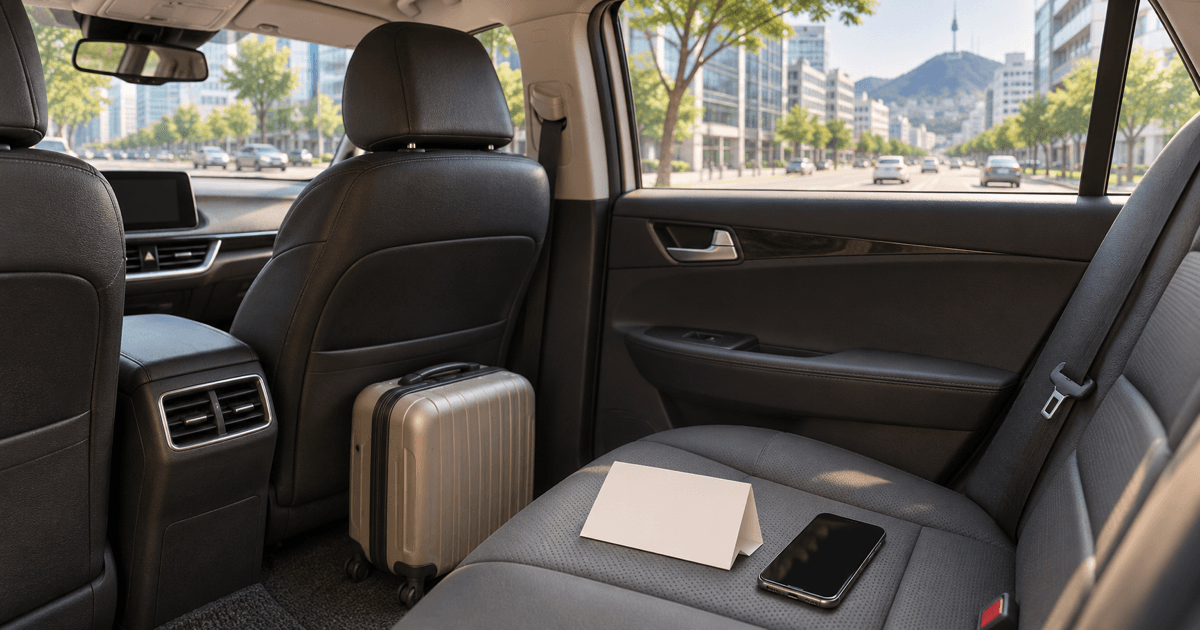
To take a taxi in South Korea without speaking Korean, save your destination’s Korean name and full address, use a taxi stand or a booking app you have already set up, and confirm the destination and payment method before leaving. With an app booking, match the vehicle to the booking and check the pickup point. Keep a paper address card and some Korean won as a backup.
The difficult moment is often a small detail: two hotel branches with similar names, a pickup pin across a busy road, or uncertainty about whether the app has already charged you. You can handle those details with a clear address, a few polite phrases, and short messages that ask one question at a time.
Can you use Korean taxis without having a conversation in Korean?
Yes. A trip needs a shared destination and a workable payment method; fluent conversation is optional. Show the address while the taxi is stationary and wait for the driver to acknowledge it before setting off.
Avoid relying on an English hotel name alone. Ask your accommodation to send its Korean name, full street address, and correct entrance. Save the actual message rather than retyping unfamiliar characters. For a restaurant or shop, include the branch and neighborhood so that a familiar chain name does not send you to a different location.
| Your situation | Useful first option | Confirm before committing |
|---|---|---|
| You are near a station or busy shopping area | Follow signs to a taxi stand | Destination, vehicle suitability, and payment |
| You need a car to come to you | A visitor-friendly booking app | Pickup pin, vehicle details, fare information, and payment mode |
| You want language support for an airport transfer around Seoul | An International Taxi reservation | Accepted booking, terminal, meeting point, language, and price terms |
| You cannot resolve an address or pickup | Ask hotel or transport information staff for help | The exact destination and where you should wait |
The Korea Tourism Organization describes taxi stands at major stations, terminals, and shopping areas. It also distinguishes ordinary taxis from language-support services. A regular taxi booking does not promise an English-speaking driver. KTO taxi guide.
What should you save before leaving your hotel?
Make one destination card for the outward trip and another for your return accommodation. Keep these details together:
- The Korean place name and full address, copied from the business or accommodation.
- The branch, entrance, or station exit you actually need.
- A screenshot showing the location and nearby streets.
- The destination’s contact number, especially if staff can help with directions.
- For an airport trip, the airport and terminal from your current flight information.
A screenshot helps explain a location; it is not live navigation. A saved pin is also worth checking against the written address before booking. If they disagree, resolve the mismatch with the venue rather than choosing whichever result appears first.
Keep the address card easy to open without scrolling through passport photos, reservation codes, or unrelated personal messages. On paper, write the accommodation’s name and contact details clearly enough for someone else to read.
Which app is practical for a foreign visitor?
One option is k.ride, operated by Kakao Mobility. Its official site lists an English interface, destination search in multiple languages, automatically translated driver chat, and auto-payment. Kakao Mobility also lists Google, Apple, or email sign-up and overseas-issued card support. Complete registration and payment setup while you have a reliable connection. k.ride official guide, Kakao Mobility service information.
These features help with language and registration, but your actual booking screen matters. Check the available vehicle categories, payment method, estimated fare, and any displayed booking or cancellation conditions. Do not assume a payment option in one app exists in another, or that every foreign-issued card will be accepted successfully.
If setup fails, switch to a staffed taxi stand or ask your hotel to help arrange a taxi. Repeatedly trying to register a card beside a busy road is a poor backup plan. An installed app also does not guarantee a nearby car, particularly when your return journey starts somewhere quiet.
How do you book and find the correct car?
Use this sequence before every app trip:
- Check the destination. Compare the Korean address and branch with your saved card.
- Check the pickup. Confirm which side of the road, building entrance, or station exit the pin represents.
- Review the booking. Read the vehicle category, price information, payment arrangement, and cancellation terms.
- Wait at the agreed point. If the location is unsuitable, communicate through the booking rather than wandering away without a message.
- Match the car. Compare the vehicle and registration details with the app before getting in.
- Confirm the destination again. Show the saved address and allow a moment for the driver to check it.
In translated chat, concrete messages work better than “I’m here.” Try: “I am at the hotel’s main entrance, beside the glass doors.” Add only landmarks you can actually see. If the driver replies with an unfamiliar place name, ask staff to help identify it before moving.
For a taxi taken from a stand, start with the address and payment question. Keep the exchange brief and let the driver enter or inspect the destination while stopped.
Which Korean phrases are useful in a taxi?
These polite requests appear in Jeju Tourism’s official English guidebook. They use standard Korean suitable for this travel situation, rather than Jeju dialect. The destination placeholder is something to replace or point to, not a word to pronounce. Official Jeju Tourism Guidebook, Korean for Tourists, printed pages 26–27.
| What you need | Korean | Romanization |
|---|---|---|
| Please go to [destination] | [destination]까지 가주세요 | [destination]kkaji gajuseyo |
| Please stop here | 여기서 세워주세요 | yeogiseo sewojuseyo |
| Do you accept credit cards? | 신용카드 되나요? | sin-yongkadeu doenayo? |
| Please give me a receipt | 영수증 주세요 | yeongsujeung juseyo |
Romanization helps you recognize the sounds; it is not an English pronunciation key. In particular, eo and eu represent Korean vowels. Listen to pronunciation before the trip, and show the Hangul when you need certainty. The polite request endings in the table are appropriate for addressing a driver you do not know.
The stop request means “Please stop here.” It does not tell the driver that a location is safe or legal for stopping. Allow the driver to choose an appropriate place. Useful words to recognize include 신용카드 for credit card and 영수증 for receipt; neither word confirms that a specific payment has succeeded.
How do payment, fares, and tipping work?
KTO lists cash, credit cards, and transportation cards as taxi payment methods and says tipping is not required. It also explains that fares vary by city, taxi type, distance, and applicable surcharges. Treat this as general guidance: confirm the method for your particular ride, and keep a backup if a card fails. KTO taxi and fare information.
For a street or stand taxi, ask about your intended payment before departure. Carry enough won for your planned journey rather than relying entirely on one foreign card. For an app ride using auto-payment, check the trip’s payment status before making a second payment to the driver. If you are asked to pay again, show the booking and resolve whether payment has failed or is still processing.
Read an estimated fare as an estimate unless the booking explicitly confirms a fixed price and its conditions. Check whether tolls or other charges are included. A premium vehicle or a language-support airport service may have different pricing from an ordinary taxi. Save the receipt or app trip record so that a later question has a concrete reference.
What is different about an airport transfer?
Decide between an on-arrival taxi and an arranged pickup before you travel. For an arranged pickup, save the confirmation, meeting instructions, operator contact, airport, terminal, and arrival date in Korean local time.
For Seoul-area International Taxi bookings, the current operator form offers Incheon Terminal 1, Incheon Terminal 2, and Gimpo as distinct choices. It also asks for passenger count, luggage, and preferred language. At the time of checking, the form requires reservations at least 48 hours ahead and specifies Korean Standard Time. Check the current form before planning around that lead time. International Taxi booking form.
Submit the real passenger and bag counts, then wait for an accepted booking and pickup instructions. A request is not the same as a confirmed vehicle. If arriving without a reservation, follow airport taxi signs and ask the official information desk which queue or service fits your trip; do not assume the advance-booking workflow applies to a walk-up ride.
For a departure, verify the terminal against current flight information. “The airport” leaves an avoidable decision to the driver.
What if the pickup, destination, or payment is wrong?
The car is across the road: Stop and clarify the pickup location in chat. Use an appropriate crossing rather than stepping into traffic to reach a car. If you must change the booking, read the cancellation conditions first.
There are several branches: Show the full address and compare it with the selected destination while stationary. Translate one correction: “This is the address I need.” Confirm the corrected location before continuing.
You do not understand a call: Use the app’s written chat if available, or ask nearby hotel or station staff to help. A visual address is often easier to resolve than trying to pronounce a long street name over a noisy call.
Payment is unclear: Keep the booking or meter amount visible and ask which payment is still outstanding. Check your app record and request a receipt. Avoid treating a bank’s pending transaction as proof that the operator has received a completed payment.
For an unresolved charge or lost item, contact the booking provider or taxi operator with the trip date, time, route, vehicle details, and receipt. Describe what happened without guessing the cause. These communication steps do not determine whether a charge is valid or guarantee a refund.
What changes for luggage, accessibility, or a rural return?
For large bags, children, or mobility needs, confirm vehicle suitability before accepting the booking. Passenger capacity alone does not establish room for luggage, wheelchair access, or availability of a suitable child restraint. Ask the operator for explicit confirmation of the arrangements you need.
For a rural attraction or a late return, arrange the return plan before leaving the staffed venue. Ask whether staff can help call a taxi and where you should wait. Save any confirmed time and contact details. Do not base the last leg of your day on the assumption that an app will immediately find a car.
If you feel unsafe, prioritize reaching a staffed public place and obtaining official local help. Translation can help explain a destination or problem; it cannot assess a driver's intentions or replace emergency assistance.
What if your phone or connection fails?
Use the paper destination card and ask a staffed hotel desk or transport information point to help you find a taxi. Show the Korean name and address, establish payment before departure, and keep the receipt.
Before leaving, check this small backup kit:
- Paper accommodation address and contact number.
- A separate card for today’s destination and correct branch.
- Saved screenshots of confirmed bookings and meeting instructions.
- Korean won for a reasonable fallback journey.
- A return plan that does not depend on finding Wi-Fi at the destination.
Saved screenshots remain useful without data, but they do not update a booking, contact a driver, or show changing traffic. Do not assume a translation or taxi app has offline functionality unless you have verified it yourself.
Where does Leyo help with a Korean taxi trip?
Leyo Translate can help you prepare a short request, understand its wording, and practice pronunciation. Use image understanding to understand text in a destination message or sign, then compare the address with information supplied by the venue.
Keep the original Korean address intact when copying it into a taxi app. Translate explanations around it rather than rewriting the address into a new form. Leyo supports communication; use the taxi provider for booking, navigation, payment status, and trip support.
Frequently asked questions
Can I take a taxi in South Korea if I only speak English?
Yes. Show the destination’s Korean name and full address, confirm payment, and use short written messages if needed. A regular taxi booking does not guarantee that the driver speaks English.
Which Korean taxi app accepts foreign cards?
Kakao Mobility lists overseas-issued card support for k.ride. Set up and verify your payment method in advance, then check the actual booking’s payment settings; support for foreign cards is not a guarantee that every issuer or transaction will work.
Do I need a Korean phone number to take a taxi?
You can use a taxi stand without registering for an app. For app use, follow the current registration requirements; k.ride lists Google, Apple, and email sign-up options, but you should complete all required setup before relying on it.
Should I show an English or Korean hotel address?
Show the Korean name and full address supplied by the hotel, including its branch or entrance. Keep the English name alongside it for your own reference.
Should I pay the driver if the app uses auto-payment?
First check the booking and payment status. If a second payment is requested, clarify whether the automatic payment failed before paying again, and retain the receipt and trip record.
How can I get back to my hotel without mobile data?
Carry its Korean address on paper, keep won available, and ask staffed accommodation or transport information points for help finding a taxi. Arrange a return pickup in advance when you will be somewhere with limited transport options.