How to Order Food in Italy Without Speaking Italian: Menus, Cafes, and Essential Phrases
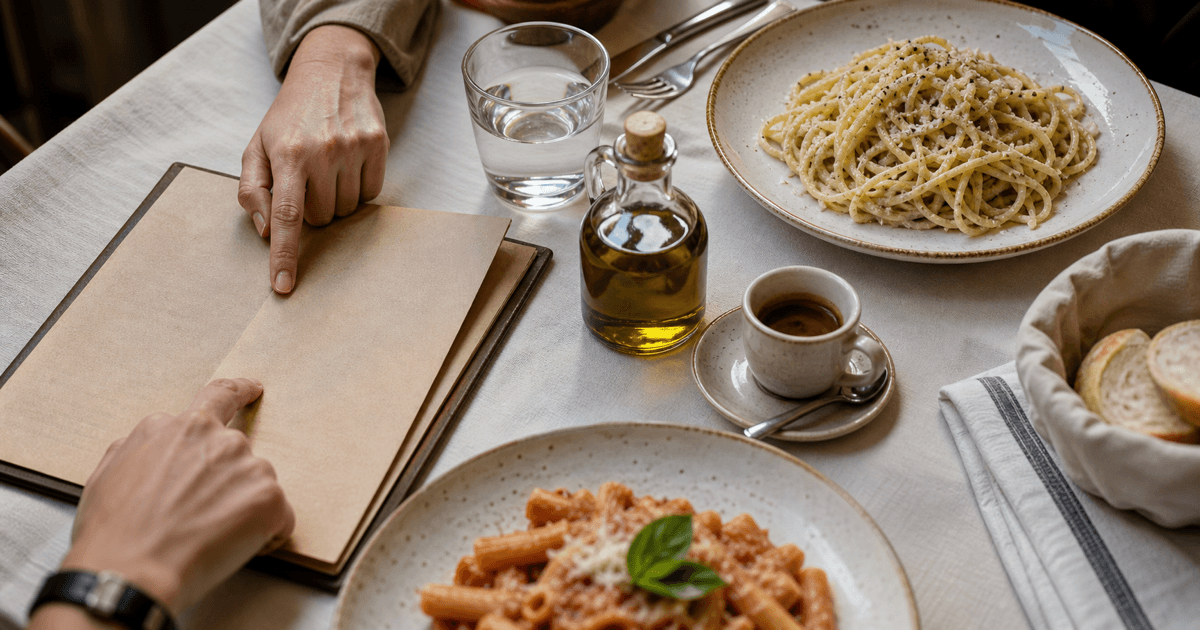
Yes, you can order food in Italy without speaking Italian. The most reliable approach is to learn a few polite phrases, understand how Italian menus are organized, use photos or translation for the dishes you cannot decode, and ask simple confirmation questions before you order or pay.
The main mistake is treating Italy like one restaurant script. A bar, pizzeria, trattoria, osteria, market stall, and fine-dining restaurant can work differently. This guide gives you the phrases, menu vocabulary, payment expectations, allergy safeguards, and offline backups that actually help in the moment.
Can you eat well in Italy without speaking Italian?
Yes, but your meal will go more smoothly if you prepare for three things: greeting people politely, reading the structure of the menu, and confirming anything that matters before the food arrives.
- Use
Buongiorno,Buonasera, orSalvebefore asking for help. - Expect menus to be organized by courses, not always by "starter, main, side" in the English sense.
- Ask for the bill when you are ready; it is normal for the server not to bring it automatically.
- Carry a card and some cash, especially for small bars, markets, rural towns, or connectivity issues.
| What you need | Best first method | Useful backup |
|---|---|---|
| A table | Say Avete un tavolo per due? |
Show the number on your fingers or phone |
| Menu help | Photograph the menu and translate it | Ask Che cosa consiglia? and point to a section |
| Allergies | Show a written allergy card in Italian | Ask for the allergen list and avoid unclear dishes |
| Payment | Ask Posso pagare con carta? before ordering |
Keep small euro notes and coins |
| The bill | Say Il conto, per favore |
Gesture writing in the air and say conto |
What should you prepare before your first meal?
Save a small Italian restaurant kit before you leave Wi-Fi. You do not need a long phrasebook; you need the few phrases that cover arrival, ordering, questions, allergies, and payment.
- Save your hotel address and any restaurant reservation offline.
- Save screenshots of your allergy or dietary restrictions in Italian.
- Download or bookmark the menu if the restaurant posts one online.
- Add a card to your phone wallet, but carry some cash for backup.
- Practice saying
vorreibecause it is the safest all-purpose ordering verb.
Italian restaurants often divide a meal into antipasti, primi, secondi, contorni, dolci, and bevande. You do not have to order from every section. A pasta from primi and a side from contorni can be enough, while a longer meal might include several courses.
How do you get a table?
Start with the greeting, then ask for a table by number. If you booked online, lead with the reservation name.
| English intent | Italian | Pronunciation |
|---|---|---|
| Hello / good day | Buongiorno | bwon-JOR-no |
| Good evening | Buonasera | bwon-ah-SEH-rah |
| Hello / polite neutral | Salve | SAHL-veh |
| Excuse me | Scusi | SKOO-zee |
| Do you have a table for two? | Avete un tavolo per due? | ah-VEH-teh oon TAH-voh-loh pehr DOO-eh |
| I have a reservation | Ho una prenotazione | oh OO-nah preh-noh-tah-TSYOH-neh |
| In the name of Liu | A nome Liu | ah NOH-meh Liu |
If the host says Avete prenotato?, they are asking whether you booked. You can answer Sì, ho prenotato if you did, or No, avete un tavolo? if you did not.
How do you read an Italian menu?
Read the menu by course and restaurant type. In Italy, menu can mean the physical menu, but menu fisso or menu degustazione means a set menu or tasting menu. Alla carta means ordering individual dishes.
| Italian menu word | What it usually means | Ordering note |
|---|---|---|
| Antipasti | Appetizers | Cured meats, vegetables, seafood, bruschetta |
| Primi | First courses | Pasta, risotto, soup; often no meat centerpiece |
| Secondi | Second courses | Meat, fish, eggs, or main protein |
| Contorni | Sides | Order separately if you want vegetables or potatoes |
| Dolci | Desserts | Cake, gelato, tiramisu, fruit |
| Bevande | Drinks | Water, wine, beer, soft drinks, coffee |
| Coperto | Cover charge | A per-person charge for table service, often shown on the menu |
| Servizio | Service charge | If included, do not feel obliged to add another tip |
Two practical details matter. First, a bar in Italy is often where you get coffee, pastries, sandwiches, aperitivo, and quick snacks, not only alcohol. Second, coffee etiquette is different from many tourist expectations: cappuccino is usually a breakfast drink, while espresso after lunch or dinner is normal.
How do you order food politely?
Use vorrei, point if needed, and confirm the number. Short sentences translate better and sound more natural than trying to build a complex speech.
| English intent | Italian | Pronunciation |
|---|---|---|
| I would like... | Vorrei... | vohr-RAY |
| For me, the pasta | Per me la pasta | pehr meh lah PAH-stah |
| As a first course, I would like... | Come primo, vorrei... | KOH-meh PREE-moh, vohr-RAY |
| As a second course, I would like... | Come secondo, vorrei... | KOH-meh seh-KON-doh, vohr-RAY |
| To drink, I would like water | Da bere, vorrei acqua | dah BEH-reh, vohr-RAY AHK-kwah |
| Still water | Acqua naturale | AHK-kwah nah-too-RAH-leh |
| Sparkling water | Acqua frizzante | AHK-kwah freet-TSAHN-teh |
| A glass of red wine | Un bicchiere di vino rosso | oon beek-KYEH-reh dee VEE-noh ROHS-soh |
| One moment, please | Un momento, per favore | oon moh-MEN-toh pehr fah-VOH-reh |
If you are nervous, order one item at a time and let the server repeat it back. Confirmation is more valuable than speed.
What if the server asks a question you do not understand?
Listen for a few predictable words. Most restaurant questions are about water, wine, cooking level, side dishes, or whether you want dessert or coffee.
| You might hear | Likely meaning | Simple answer |
|---|---|---|
Da bere? |
Something to drink? | Acqua naturale, per favore |
Naturale o frizzante? |
Still or sparkling water? | Naturale or frizzante |
Pronti per ordinare? |
Ready to order? | Sì, siamo pronti or Un momento |
Altro? |
Anything else? | No, grazie |
Caffè? |
Coffee? | Sì, un caffè or No, grazie |
Carta o contanti? |
Card or cash? | Carta or contanti |
When you are unsure, say Mi scusi, può ripetere lentamente? That means "Excuse me, can you repeat slowly?" If the answer still does not land, switch to showing the translated question on your phone.
How do you handle cafes, gelato shops, pizzerias, and markets?
The playbook changes by setting.
- Cafe or bar: In busy bars, you may pay first at the register, take the receipt, then order at the counter. Look for a cashier area and watch what locals do before joining the counter crowd.
- Gelateria: Choose the size first, then cup or cone, then flavors. Useful words:
coppettafor cup,conofor cone,gustifor flavors. - Pizzeria: A sit-down pizzeria works like a restaurant. Pizza al taglio is sold by slice or weight; point to the piece and indicate size with your hands.
- Trattoria or osteria: These are usually informal sit-down restaurants. Ask about daily specials with
Qual è il piatto del giorno? - Market stall: Pointing is normal. Ask
Quanto costa?for the price andun po' di menoif you want a smaller amount.
How do payment, tipping, coperto, and service work?
Ask about payment before ordering if you are in a small place or buying a low-cost item. Italy has become much more card-friendly, and Italian law has penalties for businesses that refuse electronic payments, but travelers should still carry small cash because terminals, connectivity, market stalls, or informal situations can fail.
For the bill, say Il conto, per favore. Do not be surprised if it takes time; lingering after a meal is normal. Check for coperto, a per-person cover charge, and servizio, a service charge. If servizio is already included, there is usually no need to add a tip. If service was especially helpful, rounding up or leaving a small amount is enough; tipping a U.S.-style percentage is not expected in ordinary restaurants.
Useful payment phrases:
| English intent | Italian | Pronunciation |
|---|---|---|
| The bill, please | Il conto, per favore | eel KON-toh pehr fah-VOH-reh |
| Can I pay by card? | Posso pagare con carta? | POHS-soh pah-GAH-reh kohn KAR-tah |
| Do you accept credit cards? | Accettate carte di credito? | aht-chet-TAH-teh KAR-teh dee KREH-dee-toh |
| Cash | Contanti | kohn-TAHN-tee |
| Receipt | Scontrino | skohn-TREE-noh |
What if you have a food allergy or medical restriction?
Treat allergies as safety-critical, not as ordinary translation. The EU requires allergen information for prepacked and non-prepacked foods, including restaurants and cafes, and the European Commission lists 14 allergens that must be clearly indicated when used as ingredients. That helps, but it does not remove the risk of cross-contact or misunderstanding.
If you have a serious allergy, bring a professionally prepared allergy card in Italian, carry your prescribed medication, and do not rely only on live machine translation. Ask for written allergen information when possible, and avoid dishes if the staff seems unsure.
| English intent | Italian | Pronunciation |
|---|---|---|
| I have a severe allergy to... | Ho una grave allergia a... | oh OO-nah GRAH-veh ah-lehr-JEE-ah ah |
| I cannot eat... | Non posso mangiare... | non POHS-soh mahn-JAH-reh |
| Does this contain milk? | Contiene latte? | kohn-TYEH-neh LAHT-teh |
| Does this contain nuts? | Contiene frutta a guscio? | kohn-TYEH-neh FROOT-tah ah GOO-shoh |
| Does this contain gluten? | Contiene glutine? | kohn-TYEH-neh GLOO-tee-neh |
| Is there a risk of cross-contact? | C'è rischio di contaminazione crociata? | cheh REE-skyoh dee kohn-tah-mee-nah-TSYOH-neh kroh-CHAH-tah |
| I need emergency medical help | Ho bisogno di assistenza medica urgente | oh bee-ZOH-nyoh dee ah-see-STEN-tsah MEH-dee-kah oor-JEN-teh |
For emergencies in Italy and across the EU, call 112. Translation can help you explain the situation, but medical decisions should come from qualified clinicians or emergency responders.
What should vegetarians, vegans, and religious diners ask?
Use short, specific ingredient questions instead of broad labels. Vegetariano and vegano are understood, but a dish can still contain cheese, anchovy, broth, lard, or egg.
| Need | Ask this in Italian | What to confirm |
|---|---|---|
| Vegetarian | È vegetariano? |
No meat or fish |
| Vegan | È vegano? |
No meat, fish, dairy, egg, honey |
| No pork | Senza maiale? |
Also ask about cured meats and lard |
| No alcohol | Senza alcol? |
Sauces, desserts, and wine reductions |
| No cheese | Senza formaggio? |
Parmesan, pecorino, cream sauces |
If the reason is religious, medical, or severe, write the restriction down in Italian and ask the staff to confirm with the kitchen. Do not rely on guessing from menu names.
Which translation mode works best at the table?
Camera translation is best for menus, chalkboards, receipts, and signs. Take a clear photo, then check dish names one by one.
Short typed translation is best for dietary restrictions, payment questions, and polite requests. Keep each message to one idea.
Voice or live conversation mode is best when the server is willing to speak into the phone, but use it respectfully. Ask first, keep the phone low, and avoid recording nearby guests.
Human escalation is best for severe allergies, medical symptoms, legal/payment disputes, or anything where a wrong translation could cause harm.
What changes in common situations?
- You are seated but no one returns: Say
Scusiwhen a server passes, thenSiamo pronti per ordinare. - The menu has no English: Translate the menu photo, identify the course, then ask about one dish at a time.
- You ordered too much: It happens. Italian courses are separate. Next time order one course first and add more if you are still hungry.
- You need tap water: Ask for
acqua del rubinetto, but expect bottled water to be the default in many restaurants. - You are in a tourist-heavy restaurant: Confirm
coperto,servizio, and card acceptance before ordering. - You are in a small town: Meal times may be stricter, English may be less available, and cash backup matters more.
What if your phone or connection fails?
Prepare for one meal without internet. That is the difference between inconvenience and stress.
- Keep screenshots of your key phrases, allergy card, reservation, and address.
- Carry a small paper card with your restrictions and emergency contact.
- Save photos of common menu words and your payment phrase.
- Bring a power bank.
- Keep cash for small purchases.
- If you are lost or unwell, ask a hotel desk, pharmacy, police officer, or restaurant manager for help instead of trying to solve everything through translation.
What is the quick ordering checklist?
Before:
- Save the restaurant address and reservation.
- Screenshot dietary restrictions in Italian.
- Check whether the restaurant has online booking or a posted menu.
- Carry card plus small cash.
During:
- Greet first:
Buongiorno,Buonasera, orSalve. - Ask for the table or show the reservation name.
- Translate the menu by section, not as one long block.
- Order with
vorreiand point if needed. - Confirm allergies or restrictions before ordering.
After:
- Ask for the bill with
Il conto, per favore. - Check for
copertoorservizio. - Save any phrase or dish name you want to remember.
Where does Leyo fit?
Leyo helps when the meal is more than a one-word translation. Use Leyo Translate to break down a menu phrase, hear pronunciation, and understand why a phrase sounds polite or too direct. Use image understanding for menus, signs, receipts, and chat screenshots from a restaurant reservation. If you are traveling with someone who speaks another language, Leyo chat and calls can keep the plan, preferences, and follow-up messages clear across languages.
For allergies, medical symptoms, or urgent safety issues, use Leyo as a communication aid, not as a substitute for professional medical help, official emergency services, or a trained interpreter.
Frequently asked questions
What is the easiest phrase for ordering food in Italy?
Use Vorrei..., which means "I would like..." It is polite, flexible, and works for food, drinks, and most simple requests.
Do I need to speak Italian in restaurants in Rome, Florence, or Venice?
Not always. Many restaurants in major tourist areas have English menus or English-speaking staff, but basic Italian greetings and confirmation phrases still make the interaction smoother and more respectful.
Should I tip in Italy?
Tipping is not expected the way it is in the United States. Check whether coperto or servizio appears on the menu or bill; if service was especially helpful, rounding up or leaving a small amount is usually enough.
Can I pay by card in Italian restaurants?
Usually, yes, especially in cities and sit-down restaurants. Still ask Posso pagare con carta? before ordering in small bars, markets, rural towns, or low-cost places, and carry some cash as backup.
What should I do if I have a severe food allergy in Italy?
Bring a professionally translated allergy card, ask for written allergen information, and avoid unclear dishes. EU allergen rules help, but severe allergies need extra caution because cross-contact and human misunderstanding can still happen.
Is it rude to use a translation app at the table?
It is fine if you use it briefly and respectfully. Translate your own menu, show short questions, and ask before using live voice translation with staff.
What if I cannot pronounce the Italian phrases well?
Lead with a polite greeting, speak slowly, and point to the phrase if needed. Clear intent matters more than perfect pronunciation.
The bottom line
To order food in Italy without speaking Italian, prepare a few polite phrases, understand the course structure, use image translation for menus, confirm restrictions clearly, and keep an offline backup. You do not need to perform fluency at the table. You need enough shared meaning for the server, the kitchen, and you to make the same meal happen.
Sources checked
- European Commission: Allergies and food safety
- European Commission: Food information to consumers legislation
- EUR-Lex: Commission notice on allergen information under Regulation (EU) No 1169/2011
- Italian Ministry of Economy and Finance tax documentation: Decreto-legge 18 ottobre 2012, n. 179, Article 15
- Duolingo Blog: How to order food in Italian in Italy
- Joy of Languages: How to order in Italian
- ThoughtCo: Essential Italian phrases to use at restaurants
- ItaliaRail: Tipping in Italy