How to Order Food in Japan Without Speaking Japanese: Meal Tickets, Table Orders, and Set Meals
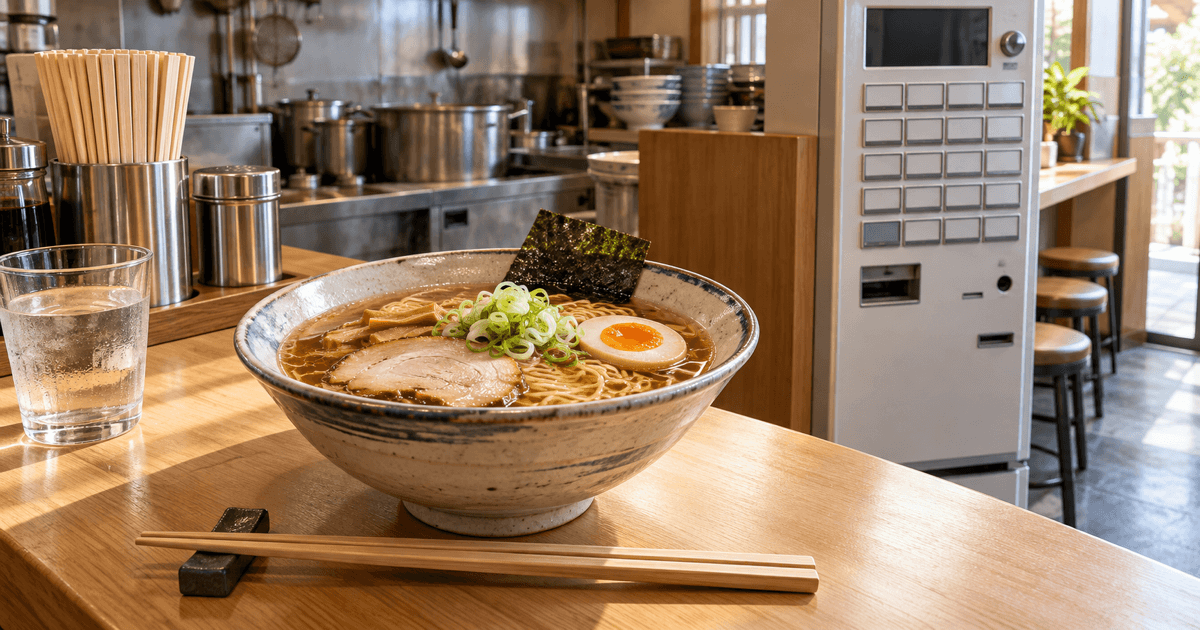
To order food in Japan without speaking Japanese, first identify how the restaurant takes orders: a meal-ticket machine, a counter, staff at your table, or a tablet. Point to the exact dish and price, confirm the quantity and any set-meal extras, and keep yen available for places that do not accept your card. If you have a serious allergy, speak to staff with a checked Japanese allergy card before paying or submitting an order.
The useful question is not just “What should I say?” It is “What happens next?” Buying a ticket can mean you have already paid, but you may still need to hand it to staff. A photo may show a set rather than the cheaper single item. This guide focuses on those moments, so you can handle a meal without first completing a Japanese course.
How do you know where to order and pay?
Pause near the entrance and observe the queue or ask staff for help before choosing a seat. The setup matters more than the size of the restaurant.
| What you see | Likely next step | What to confirm |
|---|---|---|
| Machine selling meal tickets | Choose and pay at the machine | Where the ticket goes and where to wait |
| Staff taking orders at a counter | Order there and follow pickup instructions | Whether payment is now or later |
| Staff seating guests with menus | Wait for seating, then order with staff | How to request help and where to pay |
| Tablet or QR menu at the table | Use the offered language option if available | Item, quantity, options, and final submission |
| Cafeteria trays and serving counters | Follow the displayed route | Which items are included and where checkout is |
These are clues, not universal rules. A machine may send the order directly to the kitchen, or it may print a ticket that staff need to collect. Keep any number or receipt until you understand the pickup process.
What should you prepare before entering?
Save a screenshot of a dish you want, the restaurant's name and location, and a few short phrases. Keep a photo of the actual menu line with its price, not only an English translation: staff can recognize their own wording much faster.
Carry your usual payment card and a modest yen backup. Download an offline Japanese pack if your translation tool supports it, then test it without connectivity. Save ordinary requests as screenshots, but put essential allergy information on paper as well.
For severe allergies, contact a restaurant in advance when possible. Ask about the actual ingredients and preparation, not merely whether it has an English menu. If staff cannot confirm a suitable meal, having another option planned is more useful than trying to resolve everything in a crowded queue.
How do you use a Japanese restaurant ticket machine?
A meal-ticket machine lets you choose food and pay before the meal. JNTO's ramen guide describes the common cash-machine sequence: insert money, select the items, collect change, and give the printed ticket to staff. Modern screens and cashless machines can use a different sequence, so follow the displayed instructions.
- Check the menu before paying. Match the photo to the dish name, price, and portion. Look for a language selector if one is offered.
- Check payment compatibility. Look at the accepted payment symbols and banknote denominations. Do not repeatedly insert a note the machine rejects; ask staff.
- Choose the main dish and any extras separately. A topping, extra noodles, side dish, or drink may be a separate purchase. Verify quantities before confirming.
- Collect everything dispensed. Check for tickets, receipt, change, or a pickup number. Do not leave money behind while concentrating on the order.
- Follow the restaurant's handoff. Give the meal ticket to staff if requested, or keep the pickup number if the kitchen already received the order. Wait for seating or collection instructions.
If you bought the wrong ticket, ask staff immediately before the food is prepared. A refund or change depends on the restaurant; buying a second ticket without explaining can produce two meals.
For allergy or other essential ingredient questions, stop before the purchase. A ticket machine cannot answer whether a kitchen can accommodate you.
Which Japanese phrases help with the actual order?
Use short standard Japanese with restaurant staff. The Japan Foundation's Irodori Starter Lesson 6 teaches pointing requests and eat-in/takeaway responses; Lesson 2 includes polite ways to signal that you do not understand. Its lesson page provides recordings for pronunciation practice.
| When you need it | Japanese | Romanization and meaning |
|---|---|---|
| Get staff's attention | すみません。 | Sumimasen. Excuse me. |
| Point and request a dish | これ、お願いします。 | Kore, onegaishimasu. This one, please. |
| Eat here | ここで。 | Koko de. Here, please. |
| Take away | テイクアウトで。 | Teikuauto de. For takeaway. |
| Signal a misunderstanding | すみません。わかりません。 | Sumimasen. Wakarimasen. Sorry, I do not understand. |
| Thank staff | ありがとうございます。 | Arigatou gozaimasu. Thank you. |
Romanization is a reading aid, not a complete pronunciation guide. Say the vowels clearly: roughly a as in “father,” i as in “machine,” e as in “bed,” and o as in “go” without the final glide. Japanese u is less rounded than English “oo.” In arigatou, the ou represents a long o sound. Listen to the recordings rather than adding strong English word stress.
Point to one item while you make the request, then show quantity with your fingers and let staff confirm. These polite requests work across Japan; you do not need regional slang. A request for takeaway does not mean the restaurant offers it, and it is different from asking to pack up leftovers.
What menu words prevent the most common mistakes?
Start with the structure of the meal and the process labels. A dish name alone may not tell you which sides, toppings, or preparation options come with it.
| Japanese | Reading | Meaning and useful check |
|---|---|---|
| 食券 | Shokken | Meal ticket; keep it for the restaurant's handoff |
| 定食 | Teishoku | Set meal; check its actual components |
| 単品 | Tanpin | Single item rather than a set |
| セット | Setto | Combination or set; read what is included |
| 大盛り | Oomori | Large portion; check any extra price |
| 売り切れ | Urikire | Sold out; choose another item |
| 持ち帰り | Mochikaeri | Takeaway; confirm availability |
| 会計 | Kaikei | Payment or bill; look for checkout directions |
JNTO's dining guide describes a teishoku as a meal with components served together, commonly including rice and soup. That helps explain the format, but the restaurant's listing is the authority for what your particular set contains.
A bowl that looks meat-free can still contain animal ingredients in the broth or sauce. For vegetarian, vegan, religious, or allergy needs, have staff confirm the components rather than drawing conclusions from the photograph.
What changes with table orders, tablets, and shared plates?
Staff at the table: Show the menu line while ordering. If you need help, use sumimasen at a reasonable volume or use the call button if provided. Confirm dishes one at a time, especially when the group wants different portions.
Tablet or QR order: Use a language option if offered, then check the item, quantity, customization, and final confirmation. An item in a basket is not necessarily submitted. If you cannot tell whether the order was sent, ask staff before submitting again.
Set-meal lunch: Check whether the price is for the main alone or a set. Choose any required options, such as the drink or portion, before finalizing. Do not assume every side in a display photograph comes with every version.
Izakaya with a group: Start with a small number of shared dishes and coordinate additions. JNTO explains that shared plates are common and that some venues serve a small appetizer as a table charge. Ask about that charge before settling in if it affects your choice; an automatically served appetizer is not necessarily free. JNTO dining etiquette.
Can you rely on cards, phone payments, or an IC card?
No single payment method is universal. JNTO advises visitors to check the specific establishment and carry cash because some places still require it. Look for the accepted network symbols at the entrance, machine, or checkout; show staff your actual card if unclear. JNTO payment guidance.
A transport IC card such as Suica or PASMO can be used at participating businesses displaying the relevant acceptance mark. It is not a promise that every ramen machine or restaurant accepts it. Check the machine and your balance before relying on it.
Foreign phone-payment setups can also differ from what a local terminal supports. Do not assume that seeing a contactless symbol guarantees your phone will work. If payment fails, ask which accepted method to use and keep your order receipt visible.
For a meal paid in advance, do not pay for the same meal again unless staff explain an additional charge. For a meal paid afterward, follow the venue's checkout arrangement and review the bill. JNTO says tipping is not customary in ordinary restaurants and cafes; appreciation does not require adding a tip.
How should you communicate a serious food allergy?
Treat this as a safety conversation before the order, not a menu translation task. Japan's mandatory allergen-label system covers specified ingredients in packaged processed foods. Restaurant meals are not covered by the same mandatory disclosure framework; the Consumer Affairs Agency's April 2026 briefing discusses voluntary information provision in food service. An English menu or a missing allergen icon does not establish that a dish is safe.
The CAA provides an English/Japanese Food Allergy Communication Sheet. Its download page says to download the sheet first so its checkboxes work. Complete it in advance, keep a printed copy, and have your specific allergy details checked by someone competent in Japanese. The sheet supports communication; it is not kitchen certification.
Before eating:
- Show the card to staff and ask for a chef or manager to check it.
- Discuss ingredients in broth, sauces, seasonings, toppings, and sides as well as the main dish.
- Confirm preparation risks such as a shared fryer, utensils, or work surface.
- If staff cannot confirm a suitable meal, choose another option. Removing a visible topping does not resolve cross-contact.
- Carry prescribed medication and follow your clinician's emergency plan. For a medical emergency in Japan, call 119, state your location, and ask nearby staff to help. Official ambulance-call guidance.
FARE's restaurant advice also emphasizes discussing ingredients and preparation with staff. Leyo or another translator can help convey a question, but cannot determine whether the kitchen can safely prepare your meal.
What if the answer is too fast or the order goes wrong?
Show すみません。わかりません。 and change the conversation to something visible. Have staff point to a dish, option, number, or price instead of trying to interpret a long reply.
For an unavailable dish, confirm one replacement before agreeing. For a wrong dish, keep the ticket or receipt and show the exact menu line you selected. On a tablet, show the submitted-order screen rather than adding the item again.
When translating a screen or menu, capture only the relevant section and avoid other guests or private payment information. If the answer concerns an allergy and remains unclear, do not treat a nod or a plausible translation as confirmation.
What if your battery or connection fails?
Carry a wallet-sized paper phrase card with the pointing request, “I do not understand,” and a thank-you. Keep allergy information on a separate printed card, along with your accommodation address and an emergency contact. Screenshots help without internet, but not without battery.
For an ordinary order, the printed menu, pointing, fingers for quantity, and a written price can be enough. Keep yen for a payment fallback. For safety information, find a person who can communicate reliably; do not improvise an allergy message from fragments.
Where does Leyo help during a Japanese meal?
Use Leyo Translate before entering to prepare a short request and understand its words, pronunciation, and context. Leyo's image understanding can help with a menu photo or the wording on a ticket machine: inspect the dish, price, portion, and confirmation step separately.
Save the phrase or menu word you actually used for your next meal. Keep the checked allergy card and staff conversation as your safety process; an AI explanation cannot verify ingredients or preparation.
Frequently asked questions
Do I need Japanese to order at a ramen shop?
Not necessarily. Find the ordering system, match the dish and price, and follow the ticket or staff instructions. Prepare essential ingredient questions before buying.
Do all Japanese restaurants use ticket machines?
No. Restaurants also use staff orders, counters, tablets, and other arrangements. Look at that venue's process before sitting or paying.
Should I hand my meal ticket to staff?
In the common paper-ticket system, yes, as directed. Some systems send the order electronically and give you a collection number instead. Keep the ticket and ask staff if unsure.
What is the difference between tanpin and a set?
Tanpin is a single item; a set includes a listed combination. Check the components and price rather than relying on the picture alone.
Can I pay with Suica everywhere?
No. Use it only where accepted and with sufficient balance. Keep another payment method and yen available.
Is an izakaya's automatic appetizer free?
Not necessarily. It can be part of a table charge. Check the menu or ask staff before ordering if you need to know the total cost.
Is a translated menu enough for a serious allergy?
No. Use a checked communication card and confirm ingredients and cross-contact with staff before ordering. Choose another option when they cannot confirm a suitable meal.