How to Hand Off a Project Across Languages (Checklist + Meeting Memory Template)
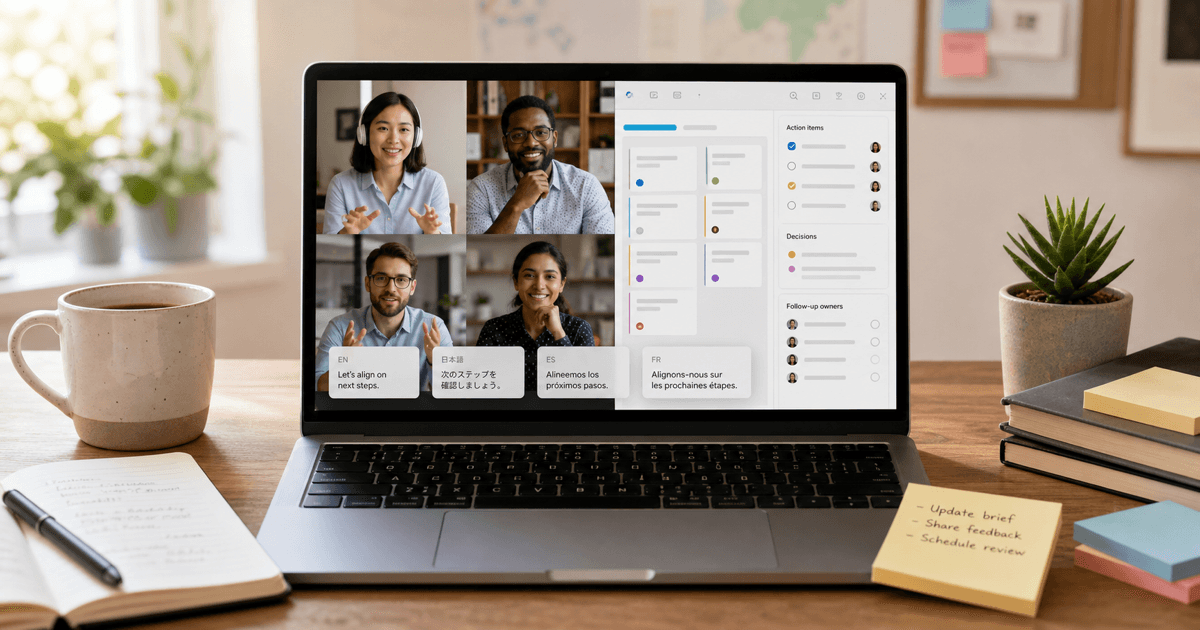
Handing off a project across languages is not just a translation task. The real risk is that the receiving team misses the context behind the work: why certain decisions were made, which tradeoffs matter, who owns the next step, and what would count as a problem.
The simplest way to make the handoff work is to treat it as three separate artifacts:
- A plain-language project brief
- A translated live handoff conversation
- A shared memory of decisions, questions, and follow-ups
If you only send documents, people may not ask the questions they need to ask. If you only run a meeting, important details disappear afterward. A good cross-language handoff gives the new team both the context and the record.
Start with the decision history, not the task list
Most handoff documents begin with tasks. That is useful, but it is not enough.
Before listing what needs to happen next, explain:
- What problem the project is solving
- Who the work is for
- What has already been tried
- Which decisions are settled
- Which decisions are still open
- Where mistakes would be expensive
This matters even more when people are working across languages and cultures. A word like "urgent," "done," "approved," or "blocked" may carry different expectations depending on the team. Spell out what those words mean in this project.
For example:
"Done" means the feature has been tested on mobile and desktop, reviewed by the product owner, and shipped to production. A local demo is not enough.
That one sentence can prevent days of confusion.
Use a short handoff brief
Keep the brief tight enough that someone can read it before the meeting.
Use this structure:
# Project handoff brief

## Goal
What outcome are we trying to create?

## Current state
What is finished, partially done, or not started?

## Key decisions
What choices have already been made, and why?

## Open questions
What still needs judgment from the receiving team?

## Risks
What could go wrong if context is missed?

## People
Who owns product, engineering, design, operations, legal, customer communication, or vendor communication?

## Next 7 days
What should happen first?
Write the brief in clear, direct language. Avoid idioms, jokes, and vague shorthand. Phrases like "circle back," "take a quick look," or "ship it when ready" can be easy to misunderstand.
Run the handoff meeting slowly
The handoff meeting should not be a presentation. It should be a shared check for understanding.
Use this agenda:
- Explain the project goal in two minutes
- Walk through what has already been decided
- Name the risks and sensitive areas
- Ask the receiving team to repeat the plan in their own words
- Capture questions as they come up
- Confirm owners and dates before ending
The most important step is number four. If the receiving team can explain the plan back to you clearly, the handoff is working. If they cannot, do not treat that as a language problem. Treat it as a clarity problem.
Translate meaning, not just words
Literal translation is helpful, but project handoffs often depend on implied meaning:
- "This is flexible" might mean the team can make changes without approval.
- "This is sensitive" might mean legal, customer, or relationship risk.
- "We need alignment" might mean a decision has not actually been made.
- "Please update the client" might mean a formal message, not a casual note.
When you use a phrase that could be interpreted more than one way, add the practical meaning right next to it.
Example:
"The launch date is flexible. That means the team may move it by up to two weeks if testing finds serious issues. Please confirm with Maya before announcing a new date to customers."
This is slower in the moment, but much faster than fixing the wrong assumption later.
Create one shared memory
After the meeting, everyone should be able to find the same record:
- What was explained
- What was decided
- What questions are still open
- Who owns each follow-up
- Which language each person prefers for important updates
This is where AI-powered communication becomes more useful than a one-time translation. Leyo Meet is being built for exactly this kind of cross-language work: live conversations where people need translation, context, shared meeting memory, and follow-ups that survive after the call ends.
The point is not to replace human judgment. The point is to make sure a project does not lose its memory every time the conversation crosses a language boundary.
Handoff meeting memory template
Use this after the meeting:
# Handoff meeting memory

## Project
Name and one-sentence purpose.

## Languages used
Who spoke which language, and which language should be used for written follow-ups?

## Confirmed decisions
- Decision:
- Why it matters:
- Owner:

## Open questions
- Question:
- Who will answer:
- Deadline:

## Risks to watch
- Risk:
- Signal that it is becoming a problem:
- Who should be notified:

## Next actions
- Action:
- Owner:
- Due date:
- Preferred language for update:
Send this record quickly, ideally the same day. Ask each person to correct anything that is wrong in their preferred language. Corrections are not a nuisance; they are the handoff becoming more accurate.
A simple checklist before you call the handoff complete
Before you consider the project transferred, confirm:
- The receiving team can explain the goal without reading the brief
- Every open question has an owner
- Every action item has a date
- Important terms have been clarified in plain language
- The decision history is saved somewhere easy to find
- Follow-ups are written in a language the owner can act on
- There is a plan for the next check-in
If any of these are missing, the handoff is not complete yet. It may look complete because the meeting happened, but the receiving team may still be guessing.
The bottom line
To hand off a project across languages, do not rely on a translated document alone. Create a short brief, run a slow confirmation meeting, translate the meaning behind important decisions, and keep one shared record of decisions and follow-ups.
Tools like Leyo Meet can help because the problem is bigger than translation. Cross-language teams need a way to understand each other in the moment and remember what happened afterward. That is what turns an international handoff from a risky transfer into a working relationship.