How to Interview a Job Candidate Who Speaks a Different First Language (Fair Questions + Scorecard)
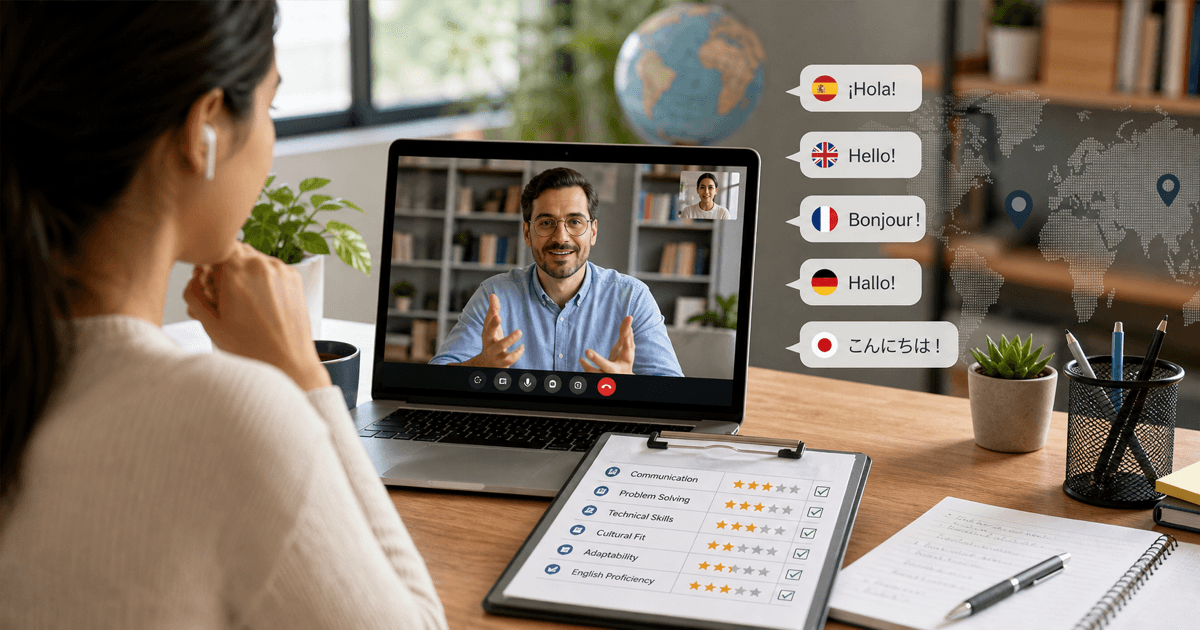
Interviewing someone across languages is not about making the conversation "easier" in a vague way. The real goal is fairness: you want to understand how the candidate thinks, whether they can do the job, and what support they would need to collaborate well, without confusing language fluency with competence.
That means you need more structure than a normal interview. A structured interview gives the candidate a better chance to show their ability, and it gives your hiring team a better record to compare candidates consistently.
Start by separating job skill from language skill
Before the interview, write down which language abilities are truly required for the role.
For example:
- Does the person need to lead live client calls in a specific language?
- Do they need to write polished customer-facing documents?
- Do they mostly need to collaborate internally across time zones?
- Can they use translation, captions, async notes, or a bilingual teammate for some workflows?
If language is not the main job requirement, do not turn the interview into a language test. A candidate may pause, ask for clarification, or use simpler words and still be excellent at product thinking, engineering judgment, operations, sales strategy, design, support, or leadership.
Send the interview structure in advance
Give the candidate a short outline before the call:
- Who they will meet
- How long each section will take
- What topics you will cover
- Whether the call will include a case, portfolio review, technical exercise, or role-play
- Whether captions, translation, or written chat are available
This helps every candidate, but it is especially useful when someone is processing in a second language. It reduces surprise and lets them prepare examples instead of spending energy decoding the format.
Use plain questions, then let them go deep
Avoid idioms, jokes, and culture-specific shorthand in the main questions. "Tell me about a time you had to push back on a stakeholder" may be clear to some people and confusing to others. A clearer version is:
Tell me about a time you disagreed with someone important on a project. What was the disagreement, what did you do, and what happened?
Good interview questions across languages usually have three parts:
- A simple setup
- A concrete example request
- A follow-up about decisions or tradeoffs
For example:
- "Tell me about a project where the requirements changed. What changed, and how did you respond?"
- "Show me a piece of work you are proud of. What problem were you solving?"
- "Describe a time you had to explain something complex to someone outside your field. How did you make it clear?"
- "When you are not sure you understood a task, what do you usually do?"
The language can be simple. The thinking can still be sophisticated.
Give candidates permission to clarify
At the start of the interview, say this directly:
If any question is unclear, please ask me to repeat it, rephrase it, or write it in chat. That will not count against you.
Then actually follow through. If the candidate asks for a rephrase, rephrase the question without acting impatient. If the candidate answers a slightly different question, check whether the issue was language before assuming they missed the point.
This is also a useful signal. In international teams, strong collaborators ask clarifying questions early instead of pretending they understand.
Keep a shared written thread during the interview
For cross-language interviews, a written backchannel is not a crutch. It is a quality-control tool.
Use it to capture:
- The current question
- Key terms or acronyms
- Links to the job description, portfolio, or exercise
- Candidate clarifications
- Follow-up items
- Names, dates, tools, and project details
This is where a cross-language chat tool like Leyo can help. You can keep the interview conversation, live translation, and notes in one place, so the candidate does not have to jump between a video call, a separate translator, a notes doc, and scattered follow-up messages.
Use a scorecard before you discuss impressions
Language differences can amplify vague feedback. One interviewer says, "They were not confident." Another says, "They took too long to answer." Those comments may be meaningful, or they may simply reflect second-language processing.
Use a scorecard tied to the role:
| Competency | What to look for | Evidence from interview | Rating |
|---|---|---|---|
| Role knowledge | Understands core work and tradeoffs | ||
| Problem solving | Breaks problems into steps, asks good questions | ||
| Collaboration | Explains assumptions, clarifies ambiguity | ||
| Communication | Can make work understandable with available tools | ||
| Follow-through | Names next steps, risks, owners, deadlines |
Ask each interviewer to fill in evidence before the group debrief. This keeps the discussion anchored in what the candidate actually did, not just how fluent or familiar they sounded.
Adjust exercises without lowering the bar
Fair does not mean easy. It means the test should measure the skill you care about.
If the role requires real-time English negotiation, a live role-play may be appropriate. If the role is mostly technical or operational, a written prompt plus discussion may be more accurate. If the role is design, product, research, or customer success, let the candidate use examples from prior work and ask follow-up questions about decisions.
Useful adjustments include:
- Share the exercise prompt in writing
- Allow a few minutes of silent reading time
- Let the candidate answer partly in writing
- Use captions or translation for clarification
- Avoid timing pressure unless speed is truly part of the job
- Ask the same core questions of every candidate
The bar stays the same: can this person do the work well in your actual environment?
Capture follow-ups immediately
After an international interview, follow-up quality matters. The candidate may need written confirmation of next steps, compensation details, immigration or relocation questions, interview feedback timing, or another conversation with a bilingual team member.
Write these down before the call ends:
- What the hiring team owes the candidate
- What the candidate owes the hiring team
- Who owns each next step
- Which language the follow-up should use
- Any context future interviewers should know
Leyo's shared meeting memory is useful here because the interview does not disappear when the video call ends. Notes, translated context, and follow-ups can stay attached to the relationship, which matters when hiring across countries, languages, and cultures.
A simple interview flow
Use this structure for a 45-minute interview:
-
0-5 minutes: Set expectations Explain the format, invite clarifying questions, and confirm whether captions or chat are useful.
-
5-15 minutes: Background and role fit Ask for one or two concrete examples from prior work.
-
15-30 minutes: Skill assessment Use a structured case, portfolio review, technical discussion, or work sample tied to the role.
-
30-38 minutes: Collaboration scenarios Ask how they handle ambiguity, disagreement, and cross-time-zone communication.
-
38-45 minutes: Candidate questions and next steps Write the next steps in chat before ending the call.
Message templates
Before the interview:
Hi [Name], looking forward to speaking with you. We will spend about 45 minutes on your background, a role-specific discussion, and your questions. If anything is unclear during the interview, you are welcome to ask us to repeat, rephrase, or write the question in chat.
During the interview:
I am going to write the question in chat as well so we have the same reference point.
After the interview:
Thank you for taking the time today. Here are the next steps we discussed: [steps]. We will follow up by [date]. If there is anything you want to clarify from the conversation, feel free to reply here.
The bottom line
To interview a candidate who speaks a different first language, make the process structured, written where useful, and evidence-based. Do not mistake accent, pauses, or simpler wording for weaker ability. Focus on whether the candidate can do the job, collaborate clearly, and follow through in the communication environment your team actually uses.
Leyo helps when that environment spans languages: Leyo Meet for live conversations, cross-language chat for clarifications, and shared meeting memory for the follow-ups that turn one interview into a fair hiring process.