How to Order Food in Turkey Without Speaking Turkish: Lokantas, Menus, and Essential Phrases
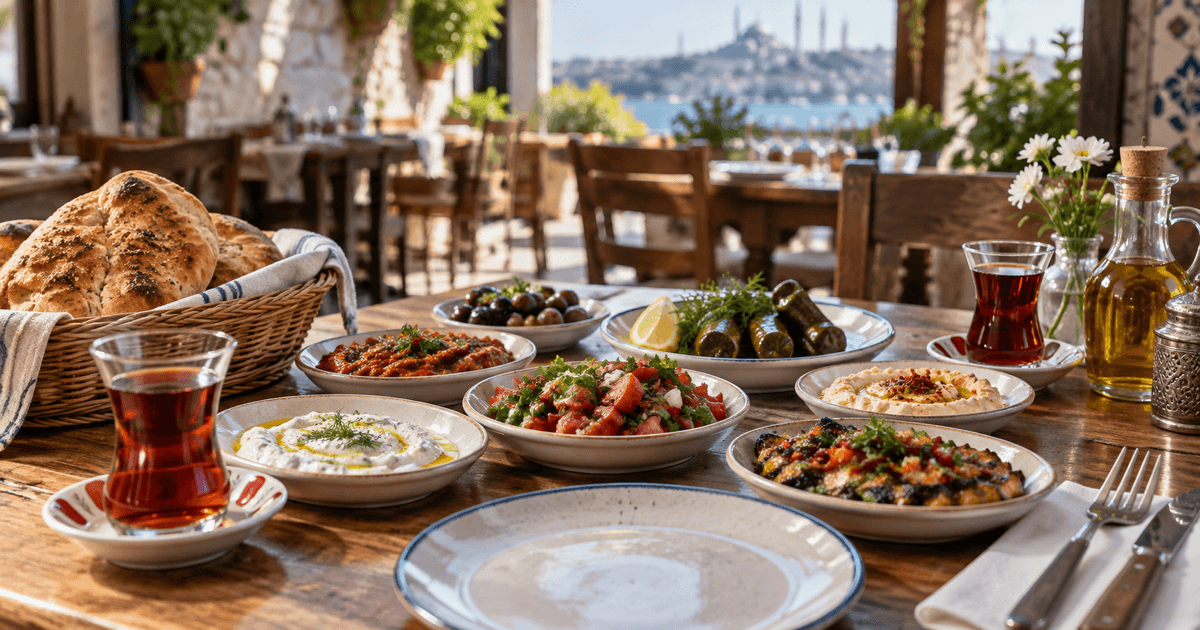
Yes, you can order food in Turkey without speaking Turkish. The easiest path is to learn a few polite Turkish phrases, recognize the type of place you are in, use photos or image translation for unfamiliar dishes, keep small Turkish lira notes for casual places, and write allergy or dietary needs in Turkish before you sit down.
The main mistake is treating every restaurant like the same workflow. A neighborhood lokanta, a kebab shop, a meyhane, a bakery, a fish restaurant, and a street-food stand all move differently. This guide gives you the phrases, menu words, payment habits, allergy wording, and offline backup that actually help in the moment.
Can you eat well in Turkey without Turkish?
Yes. In Istanbul, Cappadocia, Antalya, Izmir, Bodrum, and other tourist-heavy areas, you will often find English menus or staff who can handle simple English. Outside those areas, Turkish becomes much more useful, especially in family-run restaurants, market stalls, bakeries, and esnaf lokantası lunch spots.
You only need to solve four small problems:
- greet the staff politely before asking for help
- understand the restaurant type and ordering flow
- point to the exact dish, portion, spice, and drink you want
- confirm allergies, price, payment, and the bill before leaving
| What you need | Best first method | Useful backup |
|---|---|---|
| Read a Turkish menu | Use image translation and look for dish categories | Ask Bu ne? and point to the item |
| Order politely | Use Bir ... alabilir miyim? |
Point, hold up fingers for quantity, and smile |
| Handle payment | Ask Kart geçiyor mu? before ordering |
Carry small Turkish lira notes |
| Explain allergies | Show a written Turkish allergy card | Ask staff to call someone who can confirm ingredients |
What should you prepare before you sit down?
Prepare the boring things before you are hungry. Download Turkish for offline translation, save your hotel address, screenshot a few dish names you want to try, and write any allergy or dietary restriction in Turkish.
Also save a small restaurant note on your phone:
Merhaba. Türkçe bilmiyorum. Alerjim var. Lütfen bu notu okuyabilir misiniz?
Hello. I do not speak Turkish. I have an allergy. Could you please read this note?
If you have a serious allergy, do not rely on a live translation typed at the table. Prepare a vetted card before the trip, show it before ordering, and choose a safer restaurant if the staff seem unsure. Turkish Ministry of Agriculture and Forestry guidance says allergen information must be provided to consumers in mass-catering places such as restaurants, cafes, canteens, mobile food vehicles, and similar food-service settings, but your personal safety still depends on clear communication and cross-contact control.
How do Turkish restaurant types change the ordering flow?
The restaurant type tells you how to order.
| Place | What happens | What to say or do |
|---|---|---|
Lokanta or esnaf lokantası |
Ready-made home-style dishes sit behind glass, often for lunch | Point, choose rice or bread, pay after eating |
| Kebab or pide shop | You order a main item, then sides or ayran may come separately | Ask portion size and spice level |
| Meyhane | Shared meze and seafood, often slower and social | Ask for recommendations and confirm price for fish |
| Balık restaurant | Fish may be priced by weight | Ask Kilosu ne kadar? before agreeing |
Bakery or pastane |
Point at pastries, bread, simit, sweets | Ask for takeaway with Paket olabilir mi? |
| Street food stand | Fast pointing and cash-friendly | Keep small bills and confirm price first |
At a lokanta, you can often eat without speaking much: look, point, choose one or two dishes, and say Pilav var mı? if you want rice. At a meyhane or fish restaurant, slow down and confirm what will be charged, because shared plates and fish-by-weight can surprise visitors.
What Turkish phrases should you know?
Use short, polite phrases. Turkish staff do not need a perfect sentence from you; they need a clear request.
| English intent | Turkish | Pronunciation |
|---|---|---|
| Hello | Merhaba | mehr-hah-bah |
| Thank you | Teşekkür ederim | teh-shek-kewr eh-deh-reem |
| I do not speak Turkish | Türkçe bilmiyorum | turk-cheh bil-mee-yo-room |
| Do you have an English menu? | İngilizce menü var mı? | een-gee-leez-jeh meh-new var muh |
| What is this? | Bu ne? | boo neh |
| Can I have one ...? | Bir ... alabilir miyim? | beer ... ah-lah-bee-leer mee-yeem |
| Without onion, please | Soğansız olsun, lütfen | soh-ahn-suhz ol-soon loot-fen |
| Not spicy, please | Acısız olsun, lütfen | ah-juh-suhz ol-soon loot-fen |
| A little spicy | Az acılı olsun | az ah-juh-luh ol-soon |
| The bill, please | Hesabı alabilir miyim? | heh-sah-buh ah-lah-bee-leer mee-yeem |
| Do you accept cards? | Kart geçiyor mu? | kart geh-chee-yor moo |
| Can it be takeaway? | Paket olabilir mi? | pah-ket oh-lah-bee-leer mee |
Two pronunciation notes help. Turkish c sounds like English j, so acı is close to ah-juh. Turkish ı is not English i; it is a back, neutral vowel, so approximations like muh and suhz are only rough.
How do you order step by step?
Start with the human part, then the food part.
- Say
Merhababefore showing your phone or asking in English. - Identify the place: point-and-choose counter, table-service restaurant, bakery, or street stand.
- Open the menu or display case and translate only the dish names you are considering.
- Ask one simple question:
Bu ne?,Acılı mı?, orİçinde et var mı? - Order with
Bir ... alabilir miyim?or point and say the quantity. - Confirm any allergy or dietary need before the dish is prepared.
- Ask about card payment before you are stuck without cash.
- Check the bill, then pay and say
Teşekkür ederim.
Do not try to translate a long paragraph of preferences. Short Turkish plus pointing is usually more reliable than a perfect but complicated machine-translated message.
What menu words are worth recognizing?
These words save time when you are scanning a menu or camera translation feels messy.
| Turkish word | Meaning | Why it matters |
|---|---|---|
çorba |
soup | Often a simple first course |
meze |
small shared dish | Common in meyhanes and seafood restaurants |
pide |
boat-shaped flatbread | Often ordered by type of topping |
lahmacun |
thin flatbread with minced topping | Usually eaten with herbs and lemon |
döner |
rotating roasted meat | Can be in bread, wrap, or plate form |
köfte |
meatballs | Usually beef or lamb; ask if ingredients matter |
tavuk |
chicken | Useful for kebab and grill menus |
balık |
fish | Ask price by weight in fish restaurants |
pilav |
rice | Common side in lokantas |
yoğurt |
yogurt | Common side or ingredient |
peynir |
cheese | Important for dairy allergies |
fıstık |
pistachio or peanut depending on context | Important for nut allergies; clarify carefully |
ceviz |
walnut | Common in desserts and meze |
susam |
sesame | Common on bread, simit, and pastries |
Turkey is regional, so dish names vary. Black Sea menus may lean into anchovies and corn bread, southeastern menus may be heavier on kebab and spicy pepper, and Aegean menus often include olive-oil vegetables and seafood.
What should you know about payment, cash, and tipping?
Use cards where they are accepted, but carry cash. GoTürkiye practical information notes that credit cards are widely used and accepted and that ATMs are common. The U.S. State Department's Türkiye travel information also says credit and debit cards are accepted widely in Türkiye, but cash is useful for markets and some establishments.
In restaurants, ask before ordering:
Kart geçiyor mu?
Do you accept cards?
For tips, GoTürkiye's Turkish cuisine guide says tipping is not expected but is appreciated. In tourist restaurants, you may also see a service line such as servis bedeli; if you are unsure, ask staff to explain the bill before paying. Small cash tips are easier than trying to add a tip to a card terminal.
How do you handle allergies or dietary restrictions?
Treat allergies as a safety issue, not a translation challenge. The Turkish Ministry of Agriculture and Forestry says allergen information in food-service places can be provided through posters, writing boards, menus, and similar notices, and its guidance uses 14 allergen groups aligned with EU-style food-information rules. That helps, but it does not guarantee that every server can explain cross-contact risk in English.
Use a written Turkish card like this, adapted to your exact allergy:
| English | Turkish |
|---|---|
| I have a serious food allergy. | Ciddi bir gıda alerjim var. |
| I cannot eat peanuts. | Yer fıstığı yiyemem. |
| I cannot eat tree nuts. | Kabuklu yemiş yiyemem. |
| I cannot eat sesame. | Susam yiyemem. |
| I cannot eat milk or dairy products. | Süt ve süt ürünleri yiyemem. |
| I cannot eat eggs. | Yumurta yiyemem. |
| I cannot eat fish or shellfish. | Balık veya kabuklu deniz ürünü yiyemem. |
| Could you please check with the kitchen? | Mutfaktan kontrol edebilir misiniz? |
| If you are not sure, I cannot eat it. | Emin değilseniz bunu yiyemem. |
For vegan, vegetarian, halal, or pork avoidance, be specific. Turkish food often has vegetarian-looking dishes that may include meat stock, yogurt, butter, or minced meat. Say what you cannot eat rather than relying only on a label.
What if you do not understand the answer?
Slow the exchange down.
- Ask the staff to point to the ingredient on the menu.
- Use
Evet mi, hayır mı?for yes-or-no confirmation. - Ask
Acılı mı?if you only need to know whether it is spicy. - Ask
Et var mı?if you need to know whether there is meat. - Photograph the menu line and translate it instead of translating the whole page.
- If the answer affects an allergy, do not guess. Choose something safer or leave.
When the answer is fast and friendly but unclear, you can say Bir dakika, lütfen and translate. That small pause is better than nodding through a misunderstanding.
What changes in common situations?
At a lokanta: Look at the food first. Point to one main dish and one side. Ask Bu ne? if you are unsure. These places are good for travelers because the food is visible, but ingredients can still be mixed into stews and rice.
At a kebab shop: Decide whether you want a wrap, bread, or plate. Ask Acılı mı? before ordering if you avoid heat. Ayran, a salty yogurt drink, is common; avoid it if dairy is a problem.
At a meyhane: Expect shared plates, slower service, and more conversation. Ask prices before choosing seafood or a large spread of meze. If alcohol is involved, buy only from licensed restaurants and bars; GOV.UK warns travelers in Turkey about counterfeit alcohol and methanol risk.
At a fish restaurant: Ask for the price before a fish is weighed or prepared: Kilosu ne kadar? If you only want a small portion, be explicit. Many misunderstandings here are about quantity, not language.
At a bakery or dessert shop: Pointing works well, but allergens matter. Sesame, pistachio, walnut, dairy, egg, and gluten appear often in breads, simit, baklava, börek, and pastries.
At a market or street stand: Confirm price before ordering. Cash is common. Keep the sentence short: Ne kadar? means How much?
What if your phone, battery, or connection fails?
Have a low-tech backup.
- Carry a printed hotel card or write your address on paper.
- Keep small Turkish lira notes separate from your main wallet.
- Save an offline Turkish phrase card with allergy, payment, and bill phrases.
- Screenshot the map pin for your hotel and the restaurant.
- Print or save your allergy card in Turkish and English.
- Learn three spoken phrases:
Merhaba,Teşekkür ederim, andHesabı alabilir miyim? - If there is a medical emergency, call 112 in Türkiye. The official 112 site lists emergency services under the single number 112.
For high-stakes health, legal, or payment disputes, a translation app is only a communication aid. Use official emergency services, your travel insurer, your embassy or consulate, or a qualified interpreter when the outcome matters.
What is the quick checklist?
Before:
- Download Turkish for offline translation.
- Save your allergy or dietary note in Turkish.
- Check whether you have small Turkish lira notes.
- Screenshot dishes you want to try.
- Save 112 and your hotel address.
During:
- Start with
Merhaba. - Use short requests and point to the exact item.
- Confirm spice, meat, dairy, nuts, sesame, or seafood before ordering.
- Ask
Kart geçiyor mu?before the meal if you need to pay by card. - Check the bill before tapping or handing over cash.
After:
- Save dish names you liked.
- Note restaurants where staff handled your allergy clearly.
- Keep successful Turkish phrases for the next meal.
Where does Leyo fit?
Leyo helps when you need more than a one-word translation. Use Leyo Translate to break down Turkish menu items, hear pronunciation, and understand why a phrase such as Acısız olsun, lütfen works better than a long translated paragraph. Use image understanding for menus, signs, receipts, and chat screenshots. For a meal with local friends, a food tour, or a host family, Leyo chat, calls, or Leyo Meet can keep the conversation moving and remember the decisions or dishes you want to revisit later.
For allergies, medical emergencies, payment disputes, or official complaints, use Leyo as support, not as the authority. Prepare verified wording and escalate to a human professional when the risk is serious.
Frequently asked questions
Is English enough in Turkish restaurants?
English is often enough in tourist areas and high-end restaurants. It is less reliable in local lunch spots, markets, street-food stands, and rural areas. A few Turkish phrases plus pointing will carry you much further than English alone.
Should I say Turkey or Türkiye?
For search and everyday English, many travelers still say Turkey. The country's official English name is Türkiye, and you will see Türkiye on official tourism, government, and airport materials. In conversation at a restaurant, this difference does not matter.
How do I ask for food that is not spicy?
Say Acısız olsun, lütfen. It means Make it not spicy, please. If you can handle a little heat, say Az acılı olsun.
Can I pay by card in Turkey?
Often, yes, especially in cities and established restaurants. Still carry cash for street food, small shops, markets, tips, and rural areas. Ask Kart geçiyor mu? before ordering if card payment is important.
How do I ask for the bill in Turkish?
Say Hesabı alabilir miyim? This is polite and natural. In a very casual place, you may also hear or use Hesap, lütfen, but the longer version is safer and warmer.
What should I do if I have a serious allergy?
Prepare a Turkish allergy card before you travel, show it before ordering, and ask staff to check with the kitchen. If they seem uncertain, choose a safer restaurant or packaged food with clear labels. Do not rely on guessing from a translated menu.
What emergency number should I know in Turkey?
Call 112 for emergencies in Türkiye. Save it offline, and keep your hotel address available in Turkish or on a map pin so someone can help you communicate your location.
The bottom line
Ordering food in Turkey without Turkish is very doable if you keep the interaction simple: greet politely, identify the restaurant flow, point clearly, ask short Turkish questions, confirm allergies and payment early, and keep an offline backup. You do not need fluent Turkish to eat well; you need enough shared clarity for the person across the table to help you confidently.