How to Interview Your Grandparents When You Do Not Speak Their Language
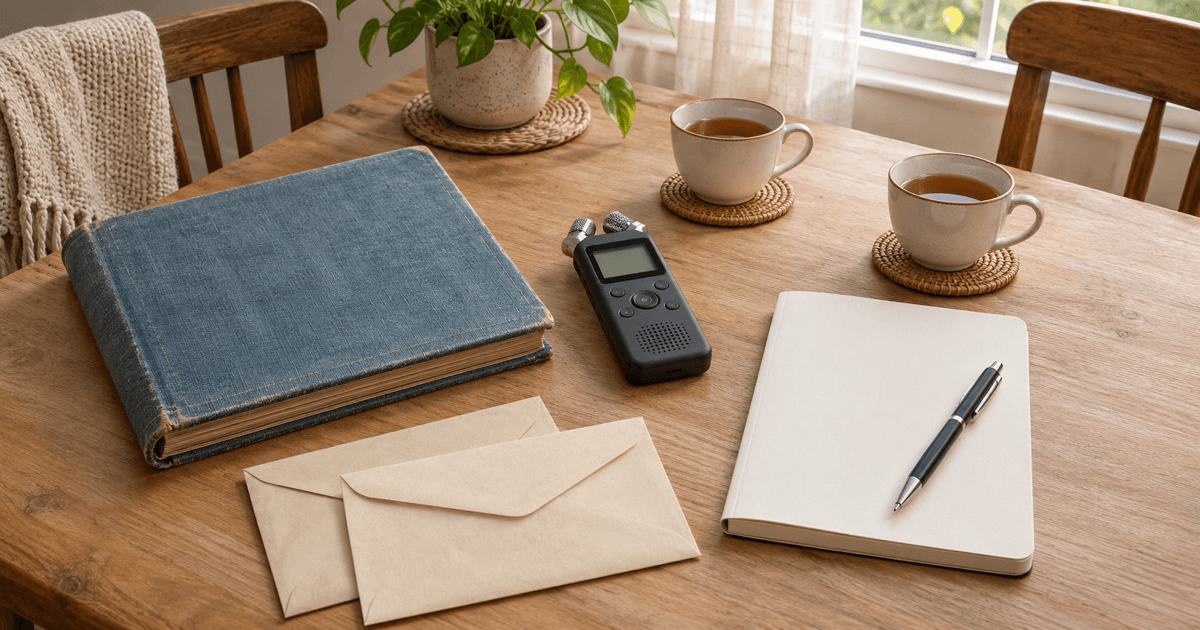
You can interview your grandparents across a language barrier by choosing one familiar topic, preparing short translated questions, and using a trusted bilingual helper or translation tool to understand each answer. Ask permission before recording, let your grandparent speak in their preferred language, and keep that original recording alongside any translation. Start with one photograph or everyday memory, then check names and unfamiliar expressions together afterward.
You do not need to cover a whole life in one sitting. A clear story about a childhood kitchen, a first job, or a family celebration can be a good first session. The aim is to hear the person behind the family role, with enough context that another relative can understand the story later.
What should your first conversation cover?
Pick one scene rather than requesting a complete biography. Ask your grandparent which topic they would enjoy discussing, and send a short explanation ahead of time in a language they understand.
Try an invitation like this, translated and checked for the way your family normally speaks:
I would like to hear about your life when you were younger. Could we talk about one family photograph? You can skip any question, and we can stop whenever you like.
The Smithsonian's family oral-history guide recommends identifying what you already know, what you want to learn, and which family materials could help. Use that preparation to find a starting point, not to turn the conversation into a test.
Choose a photo, object, or place that your grandparent recognizes. Make a copy you can both see clearly. If the photograph shows several people, give them simple reference labels in your notes, such as “person by the window,” until you have confirmed their names.
Should you use a family interpreter or a translation app?
Choose the setup that lets your grandparent answer comfortably and lets you ask follow-up questions without losing the thread.
| Situation | A useful starting setup | What to check first |
|---|---|---|
| A trusted relative understands both languages well | You ask; your grandparent answers; the relative interprets manageable sections | Everyone understands the helper's role and agrees to their presence |
| You share some vocabulary but struggle with longer answers | Prepared questions, short turns, and translation assistance | Names, dialect, and important meanings can be checked afterward |
| You live in different countries | A short call with a shared photo and an agreed translation arrangement | Audio, connection, and any separate recording setup actually work |
| The story contains sensitive family matters | A helper your grandparent chooses, or a suitable independent interpreter | Privacy, subject boundaries, and who will receive the material |
| Your grandparent dislikes devices | An unrecorded conversation with paper notes, if they agree | How they want you to remember or share the story |
Explain the helper's task: convey the question and answer, flag uncertainty, and distinguish their own comments from the speaker's words. If an answer becomes “she says childhood was difficult,” ask whether your grandparent would like to explain one particular experience. A summary may help you follow the conversation, but it can also leave out the detail you hoped to hear.
Look at and address your grandparent directly. Give the helper time to finish, then respond to the person telling the story.
What should you agree on before recording?
Discuss whether to record, where the file will be kept, who may receive it, and whether any part may be posted publicly. Explain any translation or transcription service you plan to use, including if material will be uploaded. Ask these questions in a language your grandparent understands.
The Oral History Association's best practices emphasize informed consent, explaining the project and its uses, and providing an opportunity for review before public release. Apply those principles to your family project: permission to make a recording and permission to publish a clip are separate decisions.
Keep a note of the agreement in an understandable form. Reconfirm if your plans change. If the project will be donated to an archive or published, ask the receiving organization about its consent and release requirements, and check applicable recording and privacy requirements for your circumstances. A translated sample script is not a legal release form.
If your grandparent declines recording, you can still enjoy the conversation. Ask separately whether they are comfortable with notes. Do not make a hidden recording to avoid an awkward discussion.
How do you run the interview without interrupting every sentence?
Agree on a natural pause for interpretation, then let your grandparent complete a thought. The right length depends on how well everyone can follow; do a short trial before the main story.
- Set up a quiet conversation. Reduce competing sound, place the microphone where both voices are audible, and make a brief test recording with permission. Play it back before continuing.
- Identify the session. Note the date, speakers, languages, helper, topic, and general setting. Include dialect information if your grandparent wants to describe it.
- Ask one question. Avoid packing childhood, school, siblings, and work into the same sentence.
- Listen to the answer and its interpretation. Write a keyword or time marker when something needs checking instead of interrupting every unfamiliar name.
- Ask one concrete follow-up. Invite a description of a person, place, action, or feeling already mentioned.
- Close with a check. Ask what you misunderstood, what should stay private, and whether they want another conversation.
For a first attempt, you might suggest 15–20 minutes and see how that feels; this is a planning option, not a required interview length. The Smithsonian guide recommends open questions and returning another time when the speaker becomes tired. Leave space for the story to develop without treating a prepared question list as an obligation.
Which questions translate well?
Use plain questions about one experience. Replace idioms such as “What made you tick?” with a direct question about what the person enjoyed or wanted.
| Your goal | A question to prepare for translation | A possible follow-up |
|---|---|---|
| Picture daily life | What was a normal morning like in that home? | Who was usually there? |
| Understand a photograph | What was happening when this picture was taken? | What happened just before it? |
| Learn about work | What did you do on your first day at that job? | Who showed you what to do? |
| Understand a relationship | How did you first meet this person? | What do you remember about that meeting? |
| Hear about a tradition | How did your family prepare for that celebration? | Which part did you help with? |
| Learn a family expression | What did that expression mean in your family? | When would someone say it? |
These are English source questions to adapt and verify in the language you need. Use the family name, title, and level of formality your grandparent prefers. Ask a competent speaker to check questions containing unfamiliar kinship terms or a sensitive topic.
Keep this repair question ready too:
I understood the part about the journey, but I missed who traveled with you. Could you tell me that part again?
It shows exactly where understanding broke down without asking the speaker to repeat the whole story.
How do you preserve names, dialect, and meanings that do not translate neatly?
Keep the original wording when it matters, then add an explanation. A family nickname, regional place name, or affectionate title may need more than a single English substitute.
Make a small checking log:
| Time marker | What needs checking | What you know so far | Next step |
|---|---|---|---|
| 04:10 | Name of the village | It sounds different from the modern map name | Ask for the spelling or a familiar landmark |
| 08:35 | Person called “Auntie” | Relationship not yet confirmed | Ask how this person was related to the speaker |
| 12:20 | A family saying | Literal translation sounds confusing | Ask when people used it and what it conveyed |
The entries above are illustrative. Do not fill a gap with the most plausible spelling and quietly treat it as confirmed. Keep “uncertain” visible until someone has checked it.
Separate an original-language transcript, a translation, and a short summary by labeling each clearly. If software produces any of them, treat the result as a draft. For a passage you want to quote or share, have a fluent speaker check it against the original audio, especially names, negation, dates, humor, and emotionally important wording.
What if family members remember the story differently?
Record each person's account as their account. Ask a neutral clarification such as “Was that before or after you moved?” without requiring everyone to settle the date during the interview.
The Oral History Association calls for respecting the speaker's perspective while recognizing the subjectivity of recollection. In your notes, distinguish a remembered detail from something checked against a document. If you later find a dated photograph, add that information alongside the account rather than silently rewriting what your grandparent said.
If a subject becomes uncomfortable, offer to pause, skip it, or end the conversation. Do not use translation to press for a family secret that the person has chosen not to discuss. Before sharing material about other living relatives, consider their privacy too.
What changes on a video call or when several relatives join?
On a remote call: send the photo beforehand, enlarge it where possible, and check that both the story and interpretation can be heard. Test any recording arrangement separately; being able to hear a call does not establish that your chosen recorder captures both sides.
With several relatives: choose one main speaker at a time and identify changes of speaker. Invite another person's version after the first account rather than allowing overlapping corrections that neither you nor the interpreter can follow.
With a family helper who knows the story already: ask them to convey the answer before adding their own memory. Label their additions in the notes so a future listener can tell who supplied which detail.
When reading is uncomfortable: use a spoken invitation and an object or photograph instead of a page of translated questions. Ask how your grandparent would like to check the result later; review can be a conversation, not necessarily reading a transcript.
What if the connection or recorder fails?
Have a paper question list, the selected photograph, names to check, and an agreed way to reconnect. If the call drops, note where you stopped and return to the last complete thought.
If a recording fails, say so. Ask whether your grandparent would like to repeat a short section, continue with notes, or stop for the day. Mark notes made from memory as notes; do not turn them into an apparent word-for-word quotation.
Save any translated prompts and reference images in advance and confirm that the files open without a connection. This gives you an offline reference without assuming that a translation or calling service works offline. An in-person conversation with a willing bilingual helper and paper notes can also be a complete first step.
How should you save and share the story afterward?
Keep the original recording and make separate working copies for editing or excerpts. Use a descriptive file name, such as 2026-11-09-grandparent-childhood-kitchen-original, and a note containing the language, speakers, permissions, and unresolved questions.
The Library of Congress's personal audio guidance recommends descriptive names, recording information, multiple copies in different locations, and checking that files remain readable. After copying your recording, open the copy and listen to a section. A file name visible in a folder is not enough to establish that the audio plays.
Keep the related photo, checking log, reviewed translation, and sharing agreement with the session. Send your grandparent an accessible version of what you have prepared and resolve any changes before sharing more widely. Keep an original recording private if that was the agreement; an interesting excerpt does not override it.
What is the checklist for a first session?
Before:
- Ask which language and topic your grandparent prefers.
- Agree on recording, any uploads, who can receive the result, and a way to stop.
- Choose one photo or object and prepare three short questions.
- Test the audio and arrange a helper or translation method everyone understands.
During:
- Ask one question, allow a complete thought, then interpret or clarify.
- Note time markers for uncertain names and expressions.
- Keep the speaker's answer separate from a helper's extra commentary.
- Offer a break and finish while your grandparent is still comfortable.
After:
- Open and check the original recording and its backup.
- Review important translations and label anything unresolved.
- Confirm what may be shared and with whom.
- Thank your grandparent and ask whether there is another story they would enjoy telling.
Where does Leyo help with the conversation?
Use Leyo Translate to prepare a short invitation or follow-up question and explore its wording, pronunciation, and context. For a planned remote conversation, Leyo Meet's live translation and shared notes can help participants follow the exchange and note what to check afterward.
Keep your preservation plan explicit. Check any recording and export arrangements before the session, and retain the original-language material in the agreed place. Live translation and meeting notes help understanding; passages intended for the family archive still need checking against the speaker's words.
Frequently asked questions
Can I interview my grandparents if I cannot speak their language?
Yes. Start with one topic and use prepared questions, a trusted bilingual helper, or translation assistance. Let your grandparent use their preferred language and keep a way to check anything you miss.
What should I ask first?
Choose a familiar photograph or everyday scene and ask what was happening. A concrete starting point gives you people, places, and actions to ask about next.
Should I translate every sentence immediately?
Agree on manageable pauses and try the arrangement briefly. Keep enough of each answer together for the story to make sense, while pausing before anyone loses track. Ask for clarification when needed.
Can AI translate the recording for a family history?
It can help produce a draft, but check important passages with a fluent speaker against the original recording. Label translations and summaries, and keep uncertainty visible rather than inventing missing words.
What if my grandparent does not want to be recorded?
Respect that choice. Ask separately whether notes are welcome, or simply have the conversation without documenting it. Agree on any sharing before passing the story on.
How do I stop the interview from feeling formal?
Use one photo, one curious question, and time to listen. Make skipping questions and taking breaks easy. A short conversation your grandparent enjoys gives you a good reason to talk again.