How to Run a Performance Review When You and Your Employee Speak Different First Languages
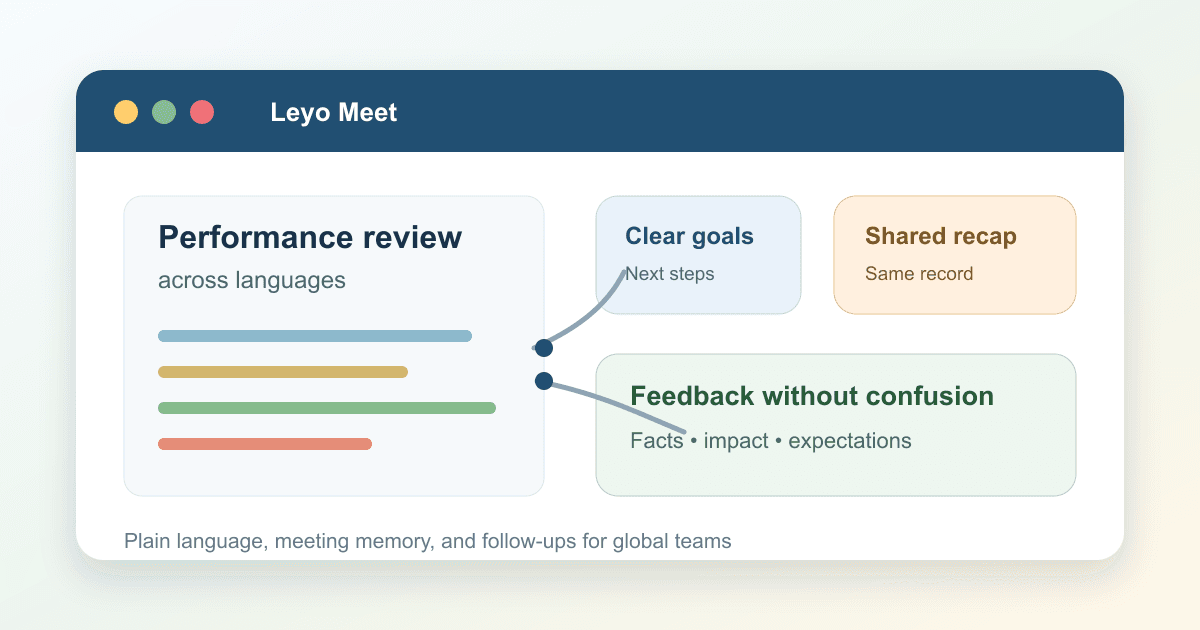
Running a performance review across languages is not just a translation problem. The hard parts are clarity, tone, power dynamics, and making sure both people leave with the same understanding of expectations.
The safest approach is to make the review more structured than usual: send the agenda early, use plain language, separate facts from interpretation, confirm understanding in writing, and keep a shared record of decisions and follow-ups.
A practical structure for the review
Use this simple format:
- What went well
- What needs to improve
- The specific examples behind the feedback
- The employee's perspective
- Next goals
- Support the manager or company will provide
- Follow-up date
Do not rely on a casual conversation to carry the whole review. In cross-language reviews, casual language can hide important meaning. A sentence like "you should be more proactive" may sound clear to the manager, but it can be hard for the employee to act on unless it is tied to a specific behavior.
Better:
In the last three sprint planning meetings, I noticed you waited until after the meeting to raise blockers. For the next month, I want you to share blockers during the meeting, even if the wording is imperfect.
That gives the employee a concrete action, not just a personality label.
Send the review outline before the meeting
Send a short outline at least 24 hours in advance. This gives the employee time to read, translate, prepare questions, and avoid being surprised by sensitive feedback in real time.
You can send something like:
Tomorrow I would like to review your progress from this quarter, discuss two areas for growth, hear your view, and agree on goals for the next month. This is a two-way conversation. Please bring any examples, questions, or support requests you want to discuss.
If the review includes serious performance concerns, say that plainly. Avoid vague warnings like "we need to talk about some things." Ambiguity creates anxiety and often translates poorly.
Use plain language instead of idioms
Avoid idioms, jokes, sarcasm, and culture-specific phrases. They can create confusion even when both people have strong working proficiency in the same language.
Instead of:
- "You need to own the room."
- "Let's get you firing on all cylinders."
- "This project went sideways."
- "You are not quite operating at the next level."
Use:
- "I want you to speak earlier in client meetings."
- "I want to help you improve in three areas."
- "The project missed the timeline because the dependency was not escalated."
- "To be promoted, you need to show consistent ownership of project planning."
The goal is not to make the conversation robotic. The goal is to make it fair.
Separate facts, impact, and expectations
A useful feedback pattern is:
Fact: What happened?
Impact: Why did it matter?
Expectation: What should happen next time?
Example:
Fact: The client status update was sent two days late.
Impact: The client did not have enough time to review the change before their internal meeting.
Expectation: For future client updates, send the draft at least one business day before the deadline, or tell me early if the deadline is at risk.
This structure reduces the chance that feedback feels like a personal attack. It also makes translation easier because each sentence has a clear job.
Check understanding without making it awkward
Do not ask, "Do you understand?" Most people will say yes, especially if the manager is senior or if they feel embarrassed.
Ask a more useful question:
Just to make sure I explained this clearly, how would you summarize the next step in your own words?
Or:
Which part of this feedback feels clear, and which part should I explain with another example?
This puts responsibility on the manager's explanation, not on the employee's language ability.
Make room for cultural differences in feedback style
In some cultures, direct negative feedback is normal. In others, it may feel harsh, disrespectful, or humiliating. Some employees may also avoid disagreeing with a manager in the meeting, even when they have important context.
Build in explicit permission:
I may be missing context. If you disagree with part of this feedback, it is okay to say so. I want us to understand the situation accurately.
Then pause. Give the employee time to respond. Silence does not always mean agreement; sometimes it means the person is translating, choosing careful words, or deciding whether it is safe to push back.
Write down decisions immediately after the meeting
After the review, send a concise recap:
- Main strengths discussed
- Growth areas
- Agreed goals
- Support promised by the manager
- Follow-up date
- Any open questions
This written recap matters more in cross-language reviews because memory can diverge quickly. One person may remember the tone of the conversation, while the other remembers a translated phrase or a single uncomfortable sentence.
A simple recap template
Subject: Performance review recap and next steps
Hi [Name],
Thank you for the conversation today. Here is my summary so we both have the same record.
Strengths we discussed:
- [Strength 1]
- [Strength 2]
Growth areas:
- [Area 1, with example]
- [Area 2, with example]
Next goals:
- [Goal 1]
- [Goal 2]
Support from me:
- [What the manager will do]
Follow-up:
- We will review progress on [date].
Please reply if I missed anything or if any wording does not match your understanding.
Where Leyo fits
Leyo is built for communication across languages and cultures, especially when the conversation should not disappear after the call ends.
For performance reviews, a tool like Leyo Meet can help teams keep a shared meeting memory: what was discussed, what each person agreed to, what follow-ups exist, and where language or cultural nuance may have affected understanding. Cross-language chat can also make the written recap and follow-up questions easier to handle without forcing everyone into the same first language.
The point is not to automate empathy. It is to reduce avoidable confusion so the manager and employee can focus on the relationship, the work, and the next step.
Bottom line
To run a fair performance review across languages, prepare more than you normally would. Use plain language, give examples, confirm understanding, invite disagreement, and write down the outcome.
If the review affects compensation, promotion, immigration status, or employment risk, do not leave meaning to memory or live translation alone. Create a shared record both people can trust.