How to Order Food in Greece Without Speaking Greek: Tavernas, Receipts, and Essential Phrases
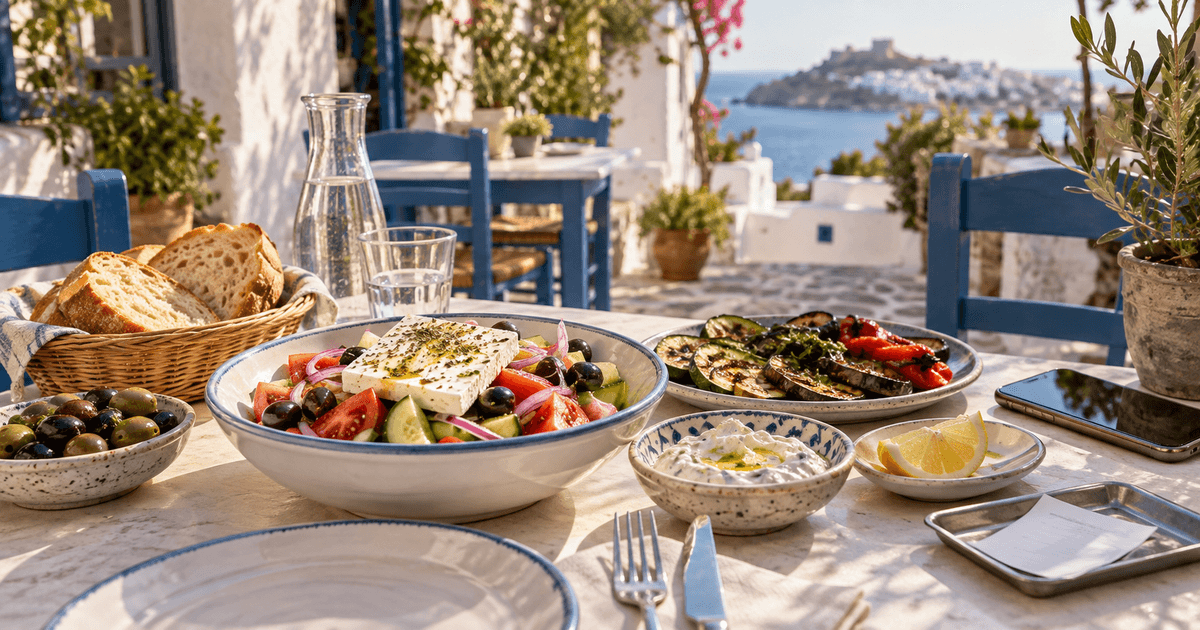
Yes, you can order food in Greece without speaking Greek. The easiest approach is to combine a few polite Greek phrases, pointing or photos, and a clear plan for menus, shared dishes, card payments, receipts, and allergies. In tavernas and casual cafes, you usually need to understand the flow more than the whole language: ask for a menu, confirm what is available today, point to dishes, ask for the bill, and make sure serious dietary needs are understood by a person, not only an app.
The main mistake is treating Greece like a single "restaurant script." A seaside fish taverna, an Athens souvlaki shop, a bakery, and a village kafeneio can all work differently. This guide gives you practical Greek phrases, local menu vocabulary, payment and receipt advice, situation playbooks, offline backups, and safety guidance for allergies or emergencies.
Can you order in Greece if you only know English?
Yes, especially in tourist areas, but do not depend on English for every detail. Many staff in Athens, islands, hotels, and popular restaurants can handle basic English, while smaller tavernas, markets, or rural stops may rely more on pointing, photos, and simple Greek.
Your three priorities are:
- Be polite at the start: a friendly
Yia sasandparakalogo a long way. - Reduce ambiguity: point, show photos, and confirm ingredients when needed.
- Separate normal preferences from safety-critical needs like allergies.
| What you need | Best first method | Useful backup |
|---|---|---|
| Choose food from a Greek menu | Photograph the menu and translate dish names | Ask "What do you recommend?" and point to what others are eating |
| Order shared plates | Use quantity plus dish name, then confirm | Show the dish photo and hold up fingers |
| Pay correctly | Ask for the bill and a receipt, then card or cash | Use the Greek phrase for receipt: apodeixi |
| Communicate an allergy | Show a written allergy card and say it out loud | Ask for a manager or choose packaged food with labels |
What should you prepare before eating out?
Prepare a tiny "restaurant kit" before you sit down. Save the address of your accommodation, your allergies or restrictions in Greek, and a few menu words offline. If you are traveling with children, older relatives, or a serious allergy, write the high-stakes details on paper too.
Before your first meal, save:
- A screenshot of your hotel address in Greek or map form.
- A short allergy or dietary note in Greek and English.
- Offline Greek in your translation app.
- Photos of foods you can safely eat.
- Emergency numbers: Greece uses 112 for emergencies, and the official Visit Greece travel tips page lists 112 plus other numbers such as ambulance 166, police 100, and tourist police 1571.
For payment, know this local rule: Greece's tax authority AADE says hotels, restaurants, bars, cafes, car rentals, and almost all suppliers of goods and services must accept debit, credit, or prepaid cards, and must issue receipts. AADE's tourist campaign says consumers are not obliged to pay if they are not given a valid receipt, called an apodeixi.
How do you actually order in a Greek restaurant?
Start simple and observable. You do not need a perfect sentence.
- Greet the staff:
Yia sasorKalimeraduring the day. - Ask for a menu:
Ehete katalogo sta anglika?if you want an English menu. - Photograph the menu if it is only in Greek, then translate dish names and ingredients.
- Decide whether the table is ordering individual mains or shared plates.
- Point to the item and say the quantity: one, two, or "for the table."
- Confirm any restriction before the order is sent to the kitchen.
- Ask for the bill:
Ton logariasmo, parakalo. - Ask for a receipt if needed:
Apodeixi, parakalo.
In many tavernas, the best food may be the day's cooked dishes rather than the longest menu section. It is normal to ask what is fresh or what they recommend.
What Greek phrases should you know?
Use short phrases. Greek grammar is rich, but restaurants reward clarity. The pronunciation below is practical tourist pronunciation, not a formal phonetic system.
| English intent | Greek | Practical pronunciation |
|---|---|---|
| Hello / goodbye | Γεια σας | yah sas |
| Good morning | Καλημέρα | ka-lee-MEH-ra |
| Please / you're welcome | Παρακαλώ | pa-ra-ka-LO |
| Thank you | Ευχαριστώ | ef-ha-ree-STO |
| Do you have an English menu? | Έχετε κατάλογο στα αγγλικά; | EH-heh-teh ka-TA-lo-go sta an-glee-KA |
| I would like to order | Θα ήθελα να παραγγείλω | tha EE-theh-la na pa-ran-GEE-lo |
| What do you recommend? | Τι προτείνετε; | tee pro-TEE-ne-teh |
| The bill, please | Τον λογαριασμό, παρακαλώ | ton lo-ga-ree-az-MO pa-ra-ka-LO |
| Receipt, please | Απόδειξη, παρακαλώ | a-PO-deek-see pa-ra-ka-LO |
| Without meat | Χωρίς κρέας | ho-REES KRE-as |
| Without cheese | Χωρίς τυρί | ho-REES tee-REE |
| I have a serious allergy | Έχω σοβαρή αλλεργία | EH-ho so-va-REE al-er-YEE-a |
Phrase sources such as Thessaloniki Travel and Athens Tourism publish restaurant Greek examples including Θα ήθελα να παραγγείλω, Δεν τρώω κρέας, and Τον λογαριασμό, παρακαλώ. For pronunciation, treat online guides as a starting point and play audio in Leyo or another trusted speech tool before relying on your own voice.
What menu words matter most in Greece?
Greek menus often make more sense when you know the category, not just the exact translation.
| Greek menu word | What it usually means | How to use it |
|---|---|---|
| Ταβέρνα / taverna | Casual Greek restaurant, often with shared dishes | Good for groups, grilled foods, salads, dips, and local specials |
| Μεζές / mezes | Small shared plate | Order several for the table |
| Σαλάτα / salata | Salad | Greek salad is often a shared dish, not a side |
| Ψάρι / psari | Fish | Ask price and portion if it is sold by weight |
| Κρέας / kreas | Meat | Useful for vegetarian restrictions |
| Κοτόπουλο / kotopoulo | Chicken | Common grilled option |
| Χοιρινό / hirino | Pork | Common in souvlaki and gyros |
| Τυρί / tiri | Cheese | Important for dairy restrictions |
| Νηστίσιμο / nistisimo | Fasting-style food, often without meat or dairy | Helpful but not a guarantee for vegan or allergy-safe food |
| Λογαριασμός / logariasmos | Bill | Ask when ready to pay |
| Απόδειξη / apodeixi | Receipt | Important in Greece because official receipts matter |
For fish tavernas, always slow down. Ask whether fish is priced per kilo, whether the price is for the whole fish, and whether sides are included. Translation apps can miss the difference between a menu description and a market-price item.
What if the waiter answers in Greek and you do not understand?
Do not pretend you understood. Smile, slow the exchange down, and switch formats.
- Point to the menu item and ask: "This one?"
- Show a translated sentence instead of speaking a long phrase.
- Ask them to type the answer into your phone.
- Use photos: "Is it like this?"
- Repeat the final choice with quantity before they leave.
- For allergies, ask them to check with the kitchen rather than guessing at the table.
Leyo is useful here because you can move between image understanding, pronunciation, and context. A menu photo can become dish-level vocabulary, and a short spoken phrase can be practiced before you say it to staff.
How do payment and receipts work in Greece?
Cards are widely expected in formal businesses, but carry some cash for small stalls, tips, ferry kiosks, remote areas, or a backup when a card machine fails. The strongest official rule for restaurant travelers is AADE's Apodixi Please guidance: restaurants, bars, cafes, and most suppliers must accept cards and issue receipts, and the receipt should be valid, not handwritten on ordinary paper.
Practical flow:
- Ask for the bill:
Ton logariasmo, parakalo. - Say card if needed:
Me karta, parakalo- by card, please. - Ask for the receipt:
Apodeixi, parakalo. - Check that the amount matches before tapping.
- If a place says cash only, stay polite but know that official AADE guidance says almost all such businesses must accept card.
Tipping is appreciated but not the same as a mandatory US-style percentage. In casual places, rounding up or leaving a few euros for good service is common. In very tourist-heavy areas, card terminals may show tip prompts; treat them as optional unless service or a listed charge clearly says otherwise.
What changes by situation?
- Taverna with shared plates: Order fewer dishes first, then add more. Greek meals often expand slowly, and plates may arrive when ready.
- Souvlaki or gyros shop: Decide pita or portion, meat type, sauce, and toppings. If you do not eat pork, ask before ordering because pork is common.
- Bakery or coffee shop: Pointing is normal. Learn
enafor one anddiofor two, or hold up fingers. - Fish restaurant: Ask price before ordering whole fish. Use translation for words like fresh, frozen, kilo, and portion.
- Market stall: Photos and pointing work well. Cash may be easier even when cards are accepted.
- Island or village restaurant: Be patient with pace and availability. The special of the day may be more reliable than a translated menu item.
How do you handle allergies or medical risk?
Treat allergies as safety-critical, not as ordinary translation. EU food information law requires allergen information for prepacked foods and mandatory allergen information for non-prepacked foods, including restaurants and cafes. In Greece, EFET is the competent food authority responsible for food safety oversight. That legal context helps, but it does not make every kitchen safe for every allergy.
Use a written card and say the risk clearly:
Έχω σοβαρή αλλεργία σε [allergen]. Μπορείτε να ρωτήσετε τον μάγειρα αν αυτό το φαγητό περιέχει [allergen] ή αν μπορεί να υπάρξει επιμόλυνση;
Meaning: "I have a serious allergy to [allergen]. Can you ask the cook whether this food contains [allergen] or whether cross-contact is possible?"
Do not rely on a single translated word for high-stakes allergies. Bring a professionally checked allergy card when possible, ask the kitchen to confirm, and choose simpler foods if the answer is uncertain. If symptoms are severe or you need urgent help, call 112. Greece's civil protection authority says 112 operates 24 hours a day and can connect emergency services; its FAQ notes operators answer in Greek, English, and French.
What is the analog backup if your phone dies?
Write your essentials on paper before leaving your hotel.
- Your hotel name and address.
- "I do not speak Greek well."
- Your allergy or medical line in Greek and English.
- Your order written as menu item names or photos printed/saved.
- Emergency number 112.
- A few euros in cash.
- The words
λογαριασμόςfor bill andαπόδειξηfor receipt.
Also take a photo of the restaurant exterior or menu if you need to return, report a lost item, or remember a dish later.
Where does Leyo fit?
Use Leyo after you already have a practical plan. Leyo Translate can break down menu words, explain whether a phrase sounds polite, and help you practice pronunciation before you speak. Image understanding helps with Greek-only menus, signs, receipts, and handwritten specials. Cross-language chat or calls can help when you need someone else in the group, a host, or a local contact to understand the plan. For serious allergies, medical issues, legal disputes, or financial problems, Leyo can help you communicate, but you should still rely on official staff, emergency services, or qualified professionals.
What is the reusable checklist?
Before:
- Save offline Greek translation and your hotel address.
- Prepare one allergy or dietary note if relevant.
- Learn
parakalo,efharisto,logariasmo, andapodeixi. - Carry a payment card and some cash.
During:
- Start politely, then point or show photos.
- Confirm dish, quantity, and restriction before staff leaves.
- Ask for the bill and receipt.
- Keep allergy communication separate from ordinary preferences.
After:
- Save the dish names you liked.
- Photograph receipts for budgeting.
- Add local food words to your Leyo memory or travel notes.
Frequently asked questions
Is it rude to speak English in Greek restaurants?
No. It is not rude in tourist areas, but opening with a Greek greeting is warmer. Use simple English, point when needed, and avoid long idioms that are hard to translate.
How do I ask for the bill in Greek?
Say Τον λογαριασμό, παρακαλώ - ton logariasmo, parakalo. It means "The bill, please." If you also need a receipt, say Απόδειξη, παρακαλώ - apodeixi, parakalo.
Can I pay by card in Greece?
Usually yes. AADE says restaurants, bars, cafes, and almost all suppliers of goods and services are obliged to accept debit, credit, or prepaid cards, with limited exceptions. Carry cash anyway for small purchases, tips, remote areas, and backup.
Are Greek menus easy for vegetarians?
They can be, but confirm ingredients. Νηστίσιμο can point toward fasting-style dishes that may avoid meat or dairy, but it is not the same as a complete vegan, vegetarian, or allergy guarantee. Ask specifically about meat, fish stock, cheese, eggs, and cross-contact if it matters.
What should I do if I have a severe food allergy?
Use a professionally checked written allergy card, show it before ordering, and ask staff to check with the kitchen. EU law requires allergen information, but cross-contact and misunderstanding are still possible. If there is any doubt, choose a safer food or leave.
What if a restaurant says the card machine is broken?
Stay calm and ask for an official receipt. AADE's tourist guidance says most restaurants and cafes must accept cards and issue valid receipts. If you are uncomfortable, pay only when you receive a valid receipt and avoid escalating with staff over a meal.
The bottom line
Ordering food in Greece without speaking Greek is very doable if you keep the exchange concrete: greet politely, point or photograph, confirm ingredients, ask for the bill, and remember apodeixi for the receipt. Use Leyo for menu understanding, pronunciation, and follow-up memory, but handle allergies and emergencies with written backups and official help. The goal is not perfect Greek. It is a relaxed meal where everyone understands enough to enjoy the table.