How to Order Food in Mexico Without Speaking Spanish: Taquerias, Fondas, Menus, and Essential Phrases
Yes, you can order food in Mexico without speaking Spanish. The most reliable approach is to learn a few Mexico-friendly phrases, recognize the type of place you are in, use photos or menu translation for unfamiliar dishes, carry pesos for smaller vendors, and keep written Spanish ready for allergies or anything that must be exact.
The main mistake is treating every meal like a formal restaurant dialogue. In Mexico, you may order at a taqueria counter, a market stall, a fonda with a daily set meal, a seafood stand, a bakery, a cafe, or a full-service restaurant. The right words are simple, but the process changes by place.
Can I order food in Mexico if I only speak English?
Yes. In major tourist areas, many restaurants have English menus or staff who can help, but you should not depend on that everywhere. Mexico's official tourism site notes that Spanish is the main language, with English commonly spoken in highly touristic destinations, so the practical plan is to use short Spanish, pointing, photos, and written notes together.
| What you need | Best first method | Useful backup |
|---|---|---|
| Choose a dish | Scan the menu with image translation, then point to the exact item | Ask ¿Qué me recomienda? |
| Control toppings | Use short words like sin cebolla, sin cilantro, poco picante |
Show a written note |
| Pay correctly | Ask ¿Aceptan tarjeta? before ordering |
Keep small bills and coins in pesos |
| Handle allergies | Show a prepared Spanish allergy card | Leave if staff seem unsure |
| Understand the bill | Ask for la cuenta and review charges |
Ask ¿Me explica este cargo? |
What should I prepare before eating out?
Prepare for the meal before you are standing in line with people behind you. Save the restaurant address, a few dish photos, key phrases, and any dietary restriction text offline. Mexico's official visitor FAQ says Mexican pesos are the only acceptable currency and recommends carrying some pesos for smaller day-to-day expenses, while cards are commonly accepted in bigger towns, cities, and tourist areas.
Before you go out:
- Save your hotel address and the restaurant name offline.
- Download Spanish for offline translation if your app supports it.
- Save a written allergy or dietary card in Spanish.
- Carry pesos in small denominations for street stands, markets, tips, and places with card minimums.
- Look up regional dishes before you arrive, because menus in Oaxaca, Yucatan, Mexico City, Jalisco, and Baja California can feel like different worlds.
How do different Mexican food places work?
The easiest ordering script depends on where you are.
| Place | How ordering usually works | What to watch for |
|---|---|---|
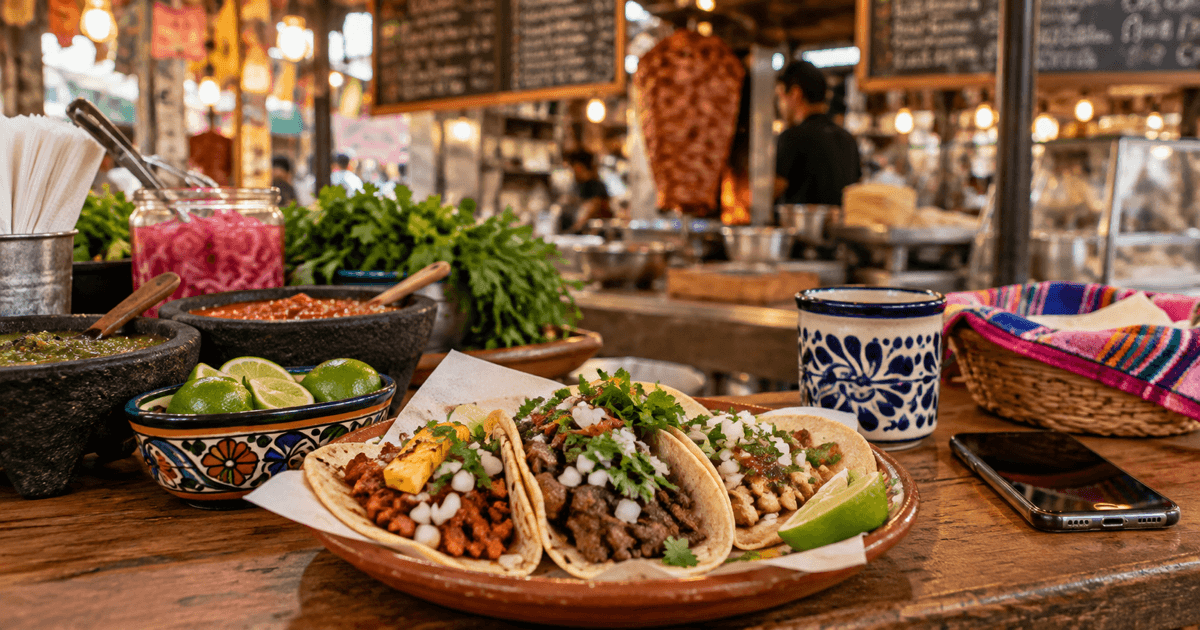
| Taqueria | Order tacos by type and quantity, then add salsa/toppings | con todo may include onion and cilantro |
| Fonda or comida corrida | Choose a set lunch from daily options | Ask what is included before ordering |
| Market stall | Point, order, pay nearby or after eating | Cash is often easiest |
| Bakery or panaderia | Take a tray and tongs, choose bread, pay at the counter | The cashier may ask if anything is missing |
| Cafe | Order at the counter or table depending on the place | Say if it is to go: para llevar |
| Full-service restaurant | Sit, order with a server, ask for the bill when ready | The check may not arrive until you ask |
What Mexican Spanish phrases should I know?
Use short, polite phrases. Mexican Spanish often sounds warmer when you add por favor, gracias, and disculpe.
| English intent | Mexican Spanish | Pronunciation guide |
|---|---|---|
| Excuse me | Disculpe | dees-KOOL-peh |
| A table for two, please | Una mesa para dos, por favor | OO-nah MEH-sah PAH-rah dohs por fah-VOR |
| Do you have a menu? | ¿Tiene menú? | TYEH-neh meh-NOO |
| What do you recommend? | ¿Qué me recomienda? | keh meh reh-koh-MYEN-dah |
| I would like this | Quisiera esto | kee-SYEH-rah ES-toh |
| I'll have three tacos | Voy a querer tres tacos | voy ah keh-REHR tres TAH-kohs |
| Without onion | Sin cebolla | seen seh-BOH-yah |
| Without cilantro | Sin cilantro | seen see-LAHN-troh |
| Not spicy | Sin picante | seen pee-KAHN-teh |
| A little spicy | Poco picante | POH-koh pee-KAHN-teh |
| To go, please | Para llevar, por favor | PAH-rah yeh-VAR por fah-VOR |
| The check, please | La cuenta, por favor | lah KWEN-tah por fah-VOR |
| Do you take card? | ¿Aceptan tarjeta? | ahk-SEP-tahn tar-HEH-tah |
Pronunciation is approximate. For anything important, play audio in Leyo Translate or another reliable source before you need to say it out loud.
How do I order tacos without getting surprised?
Start with the meat, then the quantity, then whether you want everything on it. A simple order is:
Voy a querer tres tacos al pastor, con todo, por favor.
That means: "I'll have three tacos al pastor, with everything, please."
Common taco words:
| Word | Meaning | Why it matters |
|---|---|---|
al pastor |
marinated pork, often cooked on a vertical spit | Often served with pineapple |
asada |
grilled beef | Common and usually straightforward |
carnitas |
slow-cooked pork | Often sold by cut or mixed |
barbacoa |
slow-cooked meat, often lamb or beef depending on region | Weekend and morning favorite in many places |
guisado |
stew or saucy filling | Common in markets and fondas |
con todo |
with everything | Usually onion, cilantro, salsa, maybe lime or other toppings |
sin cebolla |
without onion | Say this before the tacos are finished |
sin cilantro |
without cilantro | Useful because cilantro is common |
If you are unsure about salsa, ask ¿Pica mucho? It means "Is it very spicy?" Do not assume a green salsa is mild or a red salsa is hot. The heat depends on the chile and the cook.
How do I order at a fonda or comida corrida?
A fonda is often the best value for lunch, but it can be confusing because the menu may be spoken aloud, handwritten, or split into courses. Comida corrida usually means a set meal with several parts, often soup or rice, a main dish, tortillas, and a drink.
Use this script:
- Ask what the meal includes:
¿Qué incluye la comida corrida? - Ask for the options:
¿Qué opciones hay hoy? - Choose one item at a time:
De sopa, la de fideo. De plato fuerte, pollo. - Confirm anything you do not eat:
Sin crema, por favor. - Ask where to pay if it is not obvious:
¿Dónde pago?
If the server answers quickly, say Más despacio, por favor. That means "More slowly, please."
How do I ask about ingredients, spice, or dietary restrictions?
For preferences, short phrases work well. For medical allergies, do not rely on a casual spoken sentence. Use a written card, show it before ordering, and choose a different place if the answer feels uncertain.
| Need | Spanish to show or say | Notes |
|---|---|---|
| No pork | No como cerdo | Useful for tacos, soups, beans, and broths |
| No meat | No como carne | This may not exclude chicken broth, lard, or seafood |
| Vegetarian | Soy vegetariano/a | Add specifics if strict |
| Vegan | Soy vegano/a | Confirm dairy, cheese, cream, lard, and broth |
| No cheese | Sin queso | Cheese can appear as a topping |
| No cream | Sin crema | Common on antojitos |
| Not spicy | Sin picante | Also ask for salsa on the side |
| Salsa on the side | Salsa aparte, por favor | Useful when heat varies |
How should I handle a serious food allergy?
Treat allergy communication as safety information, not language practice. Mexico's Cofepris lists NOM-051 as the active standard for labeling prepackaged foods, but a restaurant dish, street-food item, or market meal may not give you the same certainty as a packaged label. If exposure could be dangerous, carry a professional allergy card in Spanish, keep medication with you, and choose restaurants that can answer ingredient and cross-contact questions clearly.
Show something like:
Tengo una alergia grave a [allergen]. ¿Este platillo contiene [allergen] o pudo tocar [allergen]?
That means: "I have a severe allergy to [allergen]. Does this dish contain [allergen], or could it have touched [allergen]?"
For emergency planning, Mexico uses 911 nationally for medical, safety, and civil-protection emergencies. Visit Mexico also lists 078 as a tourist-assistance line. Translation can help you explain symptoms, but it should not replace emergency care or medical advice.
How do I pay in Mexico?
Ask before you order if you are unsure: ¿Aceptan tarjeta? In cities and tourist areas, cards are common. In markets, small stands, taxis, neighborhood bakeries, and some taquerias, cash can still be the smoothest option. Use pesos rather than assuming U.S. dollars will be accepted.
Mexico's consumer-protection agency Profeco says restaurants and bars should display prices clearly, include taxes, provide a receipt, and indicate accepted payment methods. Profeco also says businesses should not add unauthorized charges, and Mexico's financial-consumer agency Condusef recommends reviewing the total before paying by card and asking for the payment terminal at your table.
Useful payment phrases:
¿Aceptan tarjeta?- Do you take card?¿Aceptan efectivo?- Do you take cash?¿Dónde pago?- Where do I pay?¿Me trae la cuenta, por favor?- Could you bring the bill, please?¿Me da ticket, por favor?- Could I have a receipt, please?¿Me explica este cargo?- Could you explain this charge?
Do I need to tip in Mexico?
Tipping is customary but should be voluntary. Visit Mexico describes 10% to 15% as customary for meals or drinks in restaurants, bars, and street stands. Profeco states that tips cannot be required or added to the bill without the customer's consent.
The practical rule:
- At a full-service restaurant, check the bill first, then leave 10% to 15% when service was good.
- At a casual stand, tip if there is table service or someone helped you beyond a quick counter sale.
- If a charge looks like an automatic tip, ask
¿La propina ya está incluida? - If you do not want to add a card tip, Condusef recommends filling or crossing out the tip line yourself.
What if I do not understand the reply?
Do not pretend to understand. Slow the exchange down and turn it into something visible.
Try this sequence:
Perdón, no entiendo.- Sorry, I do not understand.Más despacio, por favor.- More slowly, please.¿Me lo puede escribir?- Can you write it for me?- Show your phone translation and ask them to point.
- Repeat the key decision:
Entonces, tres tacos y una agua, ¿correcto?
People are usually more patient when the task is clear. Your goal is not to have a perfect conversation; it is to confirm the dish, the restriction, the price, and the payment.
Which translation mode works best?
Image translation is best for menus, signs, receipts, bakery labels, and handwritten boards.
Short text translation is best for phrases you plan to say or show, especially allergies and payment questions.
Voice translation is useful when a server explains options, but use it in short turns and confirm the final choice visually.
Leyo Meet is better for longer conversations, such as asking a hotel concierge to help call a restaurant, planning a group meal, or coordinating with a local guide.
The offline backup is still important: screenshots, written Spanish, a paper allergy card, and enough cash to solve small problems without connectivity.
What changes in common situations?
- Street tacos: Decide meat, quantity, toppings, and salsa. Ask price before ordering if it is not posted.
- Seafood: Ask about freshness, preparation, and shellfish if you have allergies. Coastal menus may use regional names.
- Markets: Pointing is normal. Watch how locals order and pay.
- Breakfast: Words like
chilaquiles,huevos,pan dulce,café de olla, andjugoappear often. - Fine dining: You can ask for English, but still keep allergy and payment phrases in Spanish.
- Late-night food: Carry cash and keep your route back saved offline.
What if my phone or connection fails?
Have a low-tech plan. It feels old-fashioned until it saves dinner.
- Carry a paper card for allergies or strict dietary needs.
- Keep your hotel address written down.
- Take screenshots of the menu, map, and reservation.
- Carry small pesos in cash.
- Save a few food photos you can point to.
- Learn
disculpe,por favor,gracias,sin,con,la cuenta, andtarjeta.
What is the reusable checklist?
Before:
- Save Spanish phrases and allergy text offline.
- Carry pesos, especially small bills and coins.
- Check whether the place is a taqueria, fonda, market stall, cafe, or full-service restaurant.
- Look up two dishes you would actually enjoy.
During:
- Greet with
buenos días,buenas tardes, orbuenas noches. - Point to the exact dish and confirm toppings.
- Ask about spice before adding salsa.
- Show allergy text before ordering, not after.
- Ask whether cards are accepted before assuming.
After:
- Review the bill.
- Ask for a receipt if needed.
- Tip voluntarily based on the setting and service.
- Save any useful words you heard so the next meal is easier.
Where does Leyo fit?
Leyo helps most when you move between menu text, spoken replies, and the phrases you need to say next. Use Leyo Translate to break down unfamiliar dishes, hear pronunciation, and turn a long sentence into a short, polite Mexican Spanish phrase. Use image understanding for menus, signs, receipts, and chat screenshots. For group meals or help from a hotel, Leyo Meet can keep the conversation, decisions, and follow-up notes in one place.
For allergies, medical symptoms, charges, or legal complaints, use Leyo as a communication aid only. Keep official documents, professional translation, emergency services, or qualified help involved when the stakes are high.
Frequently asked questions
How do I ask for food to go in Mexico?
Say para llevar, por favor. If you are ordering tacos, you can say Tres tacos al pastor para llevar, por favor. At some casual places they may ask ¿Para aquí o para llevar?, meaning "For here or to go?"
What does "con todo" mean at a taqueria?
Con todo means "with everything," but the exact toppings depend on the taqueria. It often includes onion, cilantro, salsa, lime, or other house toppings. If you dislike something, say it clearly: sin cebolla, sin cilantro, or salsa aparte.
Can I use a credit card at restaurants in Mexico?
Often yes in cities, larger towns, and tourist areas, but not everywhere. Ask ¿Aceptan tarjeta? before ordering if card payment matters. Carry pesos for markets, street stands, small cafes, tips, and connectivity problems.
Is tipping required in Mexico?
No. Tipping is customary, and Visit Mexico describes 10% to 15% as common for meals or drinks, but Profeco says tips are voluntary and cannot be imposed without consent. Always review the bill before paying.
How do I say I have a food allergy in Spanish?
Say or show: Tengo una alergia grave a [allergen]. For a dish, add: ¿Este platillo contiene [allergen]? If the allergy is serious, use a prepared written card, confirm cross-contact risk, and leave if the restaurant cannot answer clearly.
What if a menu has words from an Indigenous language?
This is common in regional food names. Do not try to guess from Spanish alone. Use image translation, photos, or ask ¿Qué es esto? and ¿Qué lleva?, meaning "What is this?" and "What does it have in it?"
What is the fastest polite way to order?
Use Voy a querer... or Quisiera... plus the item, then por favor. For example: Voy a querer una quesadilla sin queso, por favor. In Mexico, polite tone matters more than grammatical perfection.
The bottom line
You can order food in Mexico without speaking Spanish if you keep the interaction simple: identify the type of place, point to the exact dish, use a few Mexico-ready phrases, confirm toppings and spice, carry pesos, and handle allergies in writing. The meal gets easier when your phone helps, but it gets safer when you also have a human, offline backup.